Should I offer a seller concession or reduce my price?
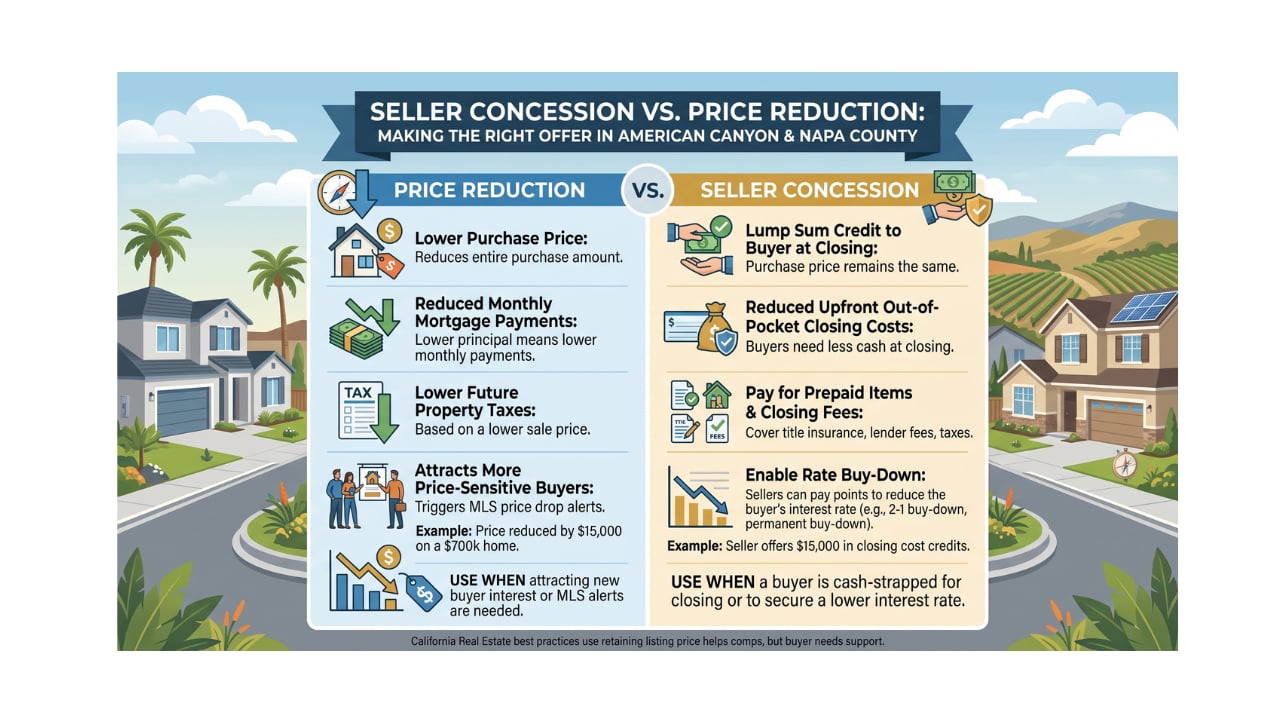
When buyers push back, a seller concession—also called a seller credit—almost always protects you better than a price cut. A concession keeps your recorded sale price intact (protecting your neighborhood's comparable values) while giving the buyer cash they can apply toward a mortgage rate buydown, closing costs, or prepaid items. A $10,000 credit toward a 2-1 buydown saves the buyer roughly $400–$450 per month in Year 1—compared to the roughly $50 per month a $10,000 price cut saves on their monthly payment. Price reductions are the right move when the home is genuinely overpriced relative to what it will appraise for, or when competing listings are actively undercutting you on price. In 2026, about 46% of U.S. home sellers are offering concessions—the highest share on record for that month, according to Redfin. Understanding which tool to use—and when—is one of the most consequential decisions in today's transaction.
By Kasama Lee, REALTOR® | RE/MAX Gold | DRE #01408667 | August 16, 2026
When a buyer comes back after inspection—or slows down in final negotiations—the first instinct is often to cut the price. And sometimes that's exactly the right move. But in today's market, sellers who understand the difference between a concession and a price reduction are closing deals that others are losing.
Here's how to think about it.
The Difference Between a Price Cut and a Seller Concession
A price reduction changes your contract price. It lowers the number the appraiser sees, the number recorded in public records as a comparable sale, and the loan amount the buyer qualifies against. If you listed at $769,000 and cut to $759,000, every one of those figures shifts—including the number your neighbors' homes will be measured against the next time one sells nearby.
A seller concession (or seller credit) keeps the contract price the same. Instead, you give the buyer a specific dollar amount at closing that they can apply toward closing costs, a mortgage rate buydown, prepaid interest, HOA dues, or other approved costs. The recorded sale price—the comp your neighborhood depends on—stays intact.
From your net proceeds standpoint, the math is identical: give $10,000 in either form and you net $10,000 less. But the impact on the buyer—and on your neighborhood's long-term value—is not identical at all.
The Math That Changes How Sellers Think About This
Assume you're selling a home in American Canyon for $769,000. The buyer asks you to come down $10,000. Let's look at what each option actually delivers.
If you cut the price to $759,000:
- The buyer's monthly payment (at 6.5%, 30-year fixed, 10% down) drops by roughly $50 per month
- Your recorded sale price is now $759,000
If you instead offer a $10,000 credit toward a 2-1 rate buydown:
- The buyer's rate is reduced 2% in Year 1 and 1% in Year 2, then reverts to their note rate
- Their payment drops by roughly $400–$450 per month in Year 1 and $200+ in Year 2
- Your recorded sale price stays at $769,000
Same $10,000 out of your pocket. Entirely different value for the buyer.
This is exactly the strategy builders at Watson Ranch use. KB Home's Sorrel community—which opened in May 2026 starting in the high $500Ks—doesn't discount its listed prices. It offers rate buydowns and closing cost packages. Keeping the contract price intact protects their other inventory. The same logic applies to resale sellers in American Canyon and across Napa County.
When a Seller Concession Makes More Sense
In most cases, in a slower or more competitive market, a well-structured concession serves everyone better than a straight price cut. Use a concession when:
- The buyer's real obstacle is cash to close, not the purchase price itself. A credit puts money where it helps—toward costs the buyer can't finance.
- You want to protect your neighborhood's comparable sale values. In Vallejo, where days on market have stretched toward 57 and buyers have more choices, a low recorded sale price ripples through future appraisals and listing prices nearby.
- The buyer is requesting a rate buydown specifically. If the buyer's lender has already proposed a buydown structure, funding it with a seller credit is often the cleanest path forward.
- You accepted an offer at full price and the buyer is now negotiating post-inspection. A credit at this stage keeps the appraisal pressure off and gives the buyer something concrete while protecting your sale price on the record.
- Your home is in excellent condition but the buyer is stretching their budget. A concession addresses affordability without suggesting anything is wrong with the home.
One important detail: seller concessions are capped by loan type. Conventional loans allow 2–9% depending on the buyer's down payment. FHA caps at 6%. VA caps at 4% plus reasonable closing costs. Your buyer's lender will confirm the limit. If a credit can't be fully absorbed because of the cap, you'll need to restructure—which is another reason to run this through your agent before agreeing to anything in writing.
If you're tracking how concessions affect your overall seller net, this works hand in hand with understanding your full closing cost picture. For a detailed breakdown of what sellers in American Canyon and Vallejo actually pay at closing—transfer taxes, escrow, title, and commission—see our guide on what to do when your house isn't selling, which covers the full reset strategy when a negotiation reaches a stall.
When a Price Reduction Makes More Sense
A concession can't solve every problem. There are situations where a price cut is the only path—and identifying them early saves a lot of time.
If your home will appraise below the contract price, a credit won't help. The lender will only loan against the appraised value. If the home appraises at $750,000 on a $769,000 contract, the buyer has a gap to cover regardless of any credits you offer. A price reduction to match the appraisal is often the only way to keep the deal together. This is the scenario where the appraisal contingency in the California purchase agreement matters most.
If competing listings are actively undercutting you on price, a concession may not be enough. Buyers comparing your home against a $749,000 similar property aren't easily won with a credit—the price gap is too visible when they're running side-by-side comparisons online. A price adjustment brings you back into range.
If your home has been sitting for 60 or more days, buyers have already developed a perception that something is wrong. A concession at that stage can feel like a band-aid on a pricing problem. A meaningful price reduction resets the conversation, can trigger fresh showing activity, and signals to the market that you're a motivated seller. This is the scenario I walk through in detail with sellers whose homes have expired or stalled—you can read more about what to do when your house isn't selling.
The concise version: use a credit when the buyer's problem is affordability mechanics. Use a price reduction when the buyer's problem is the price itself.
What Sellers in Napa and Solano County Are Actually Doing Right Now
According to Redfin's May 2026 report, 46.2% of U.S. home sellers offered some form of concession—the highest share ever recorded for May. There are roughly 47% more sellers than buyers in most markets nationally, and that supply-demand imbalance has handed buyers significant negotiating leverage in a lot of markets, including ours.
That doesn't mean you should give away value reflexively. It means you should be strategic about which tool you reach for when a buyer pushes back. A concession given thoughtfully closes deals. A price cut given reactively often invites another round of negotiation.
In American Canyon, where the current median is around $769,000, and in Vallejo, where it's closer to $523,000, the dollar stakes on this decision are real. Structuring a $15,000 concession properly on an American Canyon home keeps $769,000 on the public record. Taking a $15,000 price cut records $754,000—and that number affects your neighbors' appraisals for years.
If you're navigating this decision alongside the larger question of when to sell and what comes next, here's a guide to coordinating a sell-and-buy simultaneously—relevant if your concession strategy is part of a larger timing and financing picture.
Every situation is different. The right answer depends on your buyer's loan type, your remaining escrow timeline, where comparable sales are landing in your specific neighborhood right now, and whether your home is priced accurately for what it will appraise for. These are the exact questions I work through with every seller before a concession is offered—or before a price cut is made.
Frequently Asked Questions
What's the difference between a seller concession and a price reduction?
A seller concession (also called a seller credit) gives the buyer a specific dollar amount at closing to apply toward costs like rate buydowns, closing fees, or prepaid items—while the contract sale price stays the same. A price reduction lowers the contract price itself, which affects the appraisal comparable, the loan amount, and the public record. Both reduce your net proceeds by the same dollar amount, but they work very differently for the buyer—and for your neighborhood's comparable sale values.
How much can a seller credit a buyer in California?
Concession limits in California depend on the buyer's loan type. For conventional loans, the cap ranges from 2% to 9% of the sale price depending on the down payment (2% for down payments under 10%, 6% for 10–25% down, 9% for 25%+ down). FHA buyers can receive up to 6% of the purchase price in seller credits. VA loans cap at 4% plus reasonable closing costs. Your buyer's lender will confirm the exact maximum for your specific transaction.
Do seller concessions affect the home appraisal?
No—seller concessions don't change the appraised value. Appraisers value the property based on comparable sales and condition, not credits applied at closing. However, the concession amount is disclosed on closing documents and may be visible to future appraisers reviewing the transaction. If your home is priced above what it will appraise for, a concession won't resolve that—a price reduction will.
Should I offer a rate buydown or closing cost credit as a seller concession?
In most cases, a mortgage rate buydown—especially a 2-1 buydown—delivers more perceived value to the buyer than the same dollar amount applied to closing costs. A 2-1 buydown on a $400,000 loan costs approximately $10,000 and can save the buyer $400–$450 per month in Year 1. The same $10,000 applied to closing costs is useful, but doesn't reduce the buyer's monthly payment as meaningfully. Discuss the best structure with your agent and the buyer's lender given the buyer's specific loan situation.
What percentage of home sellers are offering concessions in 2026?
According to Redfin's May 2026 data, 46.2% of all U.S. home sellers gave concessions to buyers—the highest rate ever recorded for that month. In higher-inventory markets like Solano County (where Vallejo's days on market average around 57), concessions are increasingly expected. In tighter submarkets like Napa City (where days on market average closer to 21), sellers retain more leverage and concessions are less universal.
The concession vs. price cut decision looks simple on the surface—it's just money, right? But the mechanics of how each tool works, and the downstream effects on your neighborhood's comps, your buyer's ability to close, and your own timeline, make this one of the most consequential conversations in any negotiation.
If you're thinking through this for your own home, I'd love to walk you through the numbers in a private, no-pressure listing consultation. We can talk pricing, timing, and what your specific home looks like in today's market—no commitment, just clarity. Schedule a conversation at kasamasells.com/contact.
Not quite ready for a full conversation? You can start with a free home valuation to get a current estimate of your home's value at kasamasells.com/home-valuation.
About Kasama Lee, REALTOR®
Kasama Lee is a RE/MAX Gold Realtor® serving American Canyon, Napa, Vallejo, Fairfield, Benicia, Suisun City, and the broader Vallejo-Fairfield-Napa metro since 2004. A Best of Napa County 2024 award-winning team leader and certified real estate coach for Tom Ferry International, Kasama specializes in helping sellers and buyers navigate single-family homes, new construction, and 55+ active adult communities across southern Napa and Solano counties. With more than two decades of local market experience and a partnership with her husband Barton, a CPA, she brings both negotiation expertise and financial clarity to every transaction. Connect with Kasama at kasamasells.com.
Kasama Lee, REALTOR® | RE/MAX Gold | DRE #01408667