What happens to leased solar panels when you sell or buy a home in California?
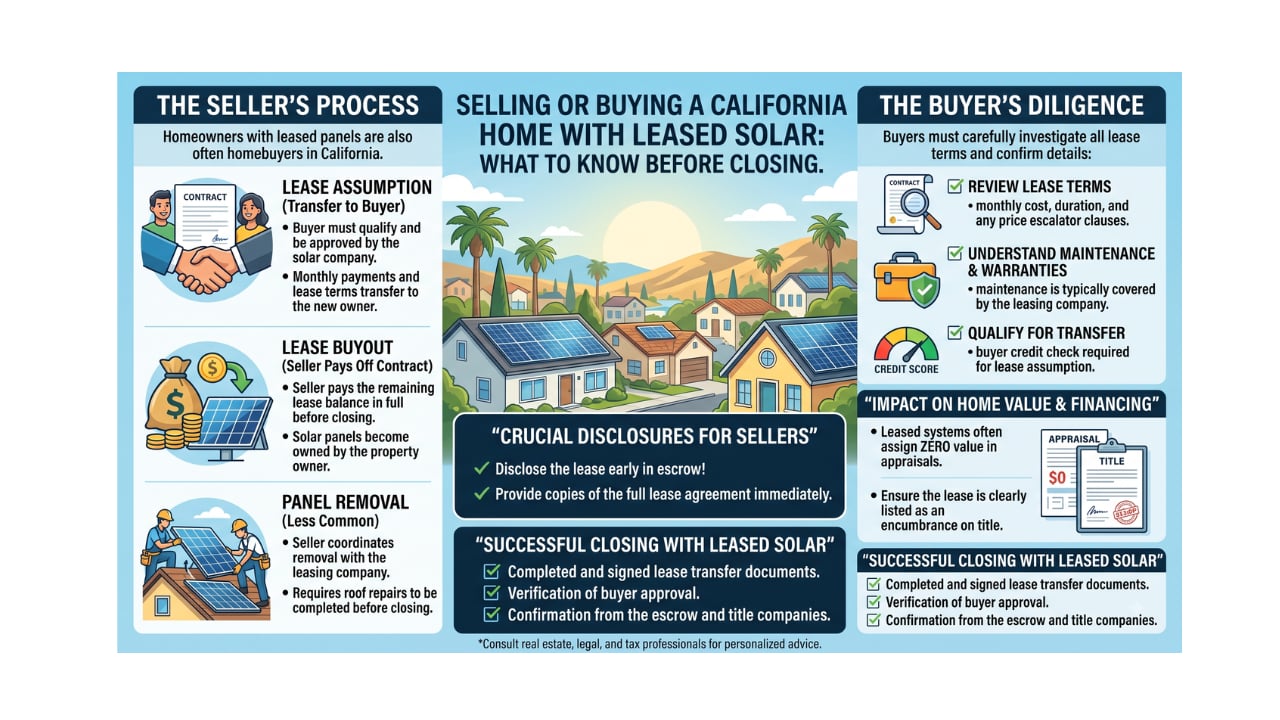
When a California home has leased solar panels — or a Power Purchase Agreement (PPA) — the solar company files a UCC-1 Financing Statement against the property, which acts as a lien. Before escrow can close, the lease must either be transferred to the buyer (who must pass the solar company's separate credit check), paid off by the seller (typically $8,000–$35,000+), or the panels must be removed. Buyers using FHA or VA financing generally cannot assume a solar lease, which can significantly shrink the buyer pool. An unresolved solar lease is one of the most common reasons California home sales get delayed or fall through at escrow.
By Kasama Lee, REALTOR® | RE/MAX Gold | DRE #01408667 | August 7, 2026
You found the house. The price is workable. The listing mentions solar panels — great, lower utility bills. Then your agent calls.
"The panels are leased. We need to talk."
This is a conversation I have regularly with buyers in American Canyon, Napa, Vallejo, and the broader Solano County market. And increasingly with sellers who discover mid-escrow that their solar agreement has $20,000 or more left on the clock — and their buyer is using an FHA loan.
Solar panel leases are a genuinely useful product when you're living in the home. They become a significant transaction complication when it's time to sell or buy. Here's what you need to know before either situation catches you off guard.
Owned vs. Leased: The Distinction That Changes Everything
When a homeowner installs solar, they have two main paths: buy the system outright (or finance it through a loan tied to the homeowner, not the property), or lease the equipment from a solar company.
With an owned system, the panels belong to the homeowner. They transfer with the property, may contribute to appraised value, and add no meaningful complexity at closing.
With a leased system — or a PPA — the solar company retains ownership of the equipment. The homeowner pays either a fixed monthly lease fee (typically $80–$250/month) or a per-kilowatt-hour rate for 15–25 years.
That distinction matters enormously in a home sale.
The UCC-1 Filing Problem
When a solar company installs leased panels, they protect their ownership interest by filing a UCC-1 Financing Statement against the property with the California Secretary of State. This is how the solar company formally establishes that they still own the equipment — even though it's bolted to your roof.
A UCC-1 doesn't function exactly like a mortgage lien, but it shows up during the title search — and title companies treat it as something that must be formally resolved before escrow can close. An unresolved UCC-1 will delay or block your closing.
This isn't a rare edge case. Solar lease UCC filings are among the most common title complications in California residential transactions today, particularly in NorCal markets like Napa and Solano counties where solar adoption runs high.
The Three Paths Forward
If you're selling or buying a home with leased solar panels, there are three ways to resolve the lease before closing.
1. Transfer the lease to the buyer
The buyer assumes the remaining lease payments and takes over the agreement with the solar company. This sounds simple. In practice, it has friction.
The solar company runs their own credit check on the incoming buyer — separate from the mortgage lender — typically requiring a score of 650–680 or higher. Requirements vary by company (Sunrun, Tesla Energy, Sunnova, and Enphase each have their own standards). Even buyers with strong credit have been denied. When that happens mid-escrow, the transaction stalls while everyone scrambles.
The larger problem: buyers using FHA or VA financing generally cannot assume a solar lease. Most pre-2023 solar lease agreements lack the foreclosure termination language FHA requires. VA appraisers treat leased equipment as an encumbrance that conflicts with VA loan requirements. In practice, this removes a meaningful portion of your qualified buyer pool before the first showing ever happens.
2. The seller buys out the lease at closing
If the buyer won't or can't assume the lease, the seller can pay off the remaining balance. Solar companies provide buyout quotes on request.
Sellers are frequently shocked by what they receive. Common buyout costs in 2026 run $8,000 to $35,000 or more, depending on years remaining and system size. A seller with a Sunrun lease and 17 years remaining received a buyout quote of $24,800. That sum comes directly out of net proceeds — often on top of price reductions and other concessions already in play.
If you have a solar lease and you're planning to sell: call your solar company now. Ask for your current payoff quote before you list. Discovering this number mid-escrow — when a buyer is already in negotiation — puts you in one of the weakest positions I see sellers in. Knowing it in advance gives you time to plan.
3. Negotiate terms into the purchase contract
Some buyers will accept a lease transfer as part of a negotiated deal, particularly when the monthly payment is low and the remaining term is manageable. But this has to be addressed explicitly in the purchase contract — not assumed. California law requires disclosure of the lease within three days of offer acceptance, and the terms must be agreed to in writing.
What Sellers Are Required to Disclose
Under California's seller disclosure law, the solar lease is a known material fact that must be disclosed. Specifically:
- The Transfer Disclosure Statement (TDS) and Seller Property Questionnaire (SPQ) require disclosure of all liens, encumbrances, and third-party agreements attached to the property. A solar lease qualifies on all three counts.
- You're required to provide the buyer with: the full lease or PPA agreement, remaining term and monthly payment, system production history, and warranty documentation — within three days of offer acceptance.
- Concealing a known solar lease is not a gray area. It's civil liability exposure under California law.
Early disclosure is the better strategy. Addressing the solar situation during the pre-listing phase — before any buyer sees the home — keeps everything transparent, avoids surprises, and protects you legally. I walk through this with every seller as part of pre-listing planning, well before we ever put the sign in the yard.
What Buyers Should Check Before Writing an Offer
If you're buying a home with solar panels — new construction at Watson Ranch or Enclave at Canyon Estates in American Canyon, or a resale anywhere across Napa or Solano County — the first question to ask is: owned or leased?
Ask your agent to confirm this before the offer is written.
If the panels are leased:
- Request a copy of the lease agreement before your inspection period ends
- Note the monthly payment and years remaining on the term
- Tell your lender upfront — if you're using FHA or VA financing, this is a problem that needs to be resolved before the offer, not during escrow
- Ask the seller how they intend to handle the lease: transfer, buy out, or negotiate into the purchase price
If you're using conventional financing and the lease terms are reasonable, a transfer can work — but build in additional time (typically one to three weeks) for the solar company's credit process. This step cannot be rushed, and it's not controlled by your lender, your agent, or escrow.
For buyers exploring new construction in American Canyon specifically, it's worth understanding how builder contracts and third-party agreements stack before you sign anything. Whether your solar is owned or leased should be confirmed at the sales office — and a buyer's agent who knows these projects will know the right questions to ask.
A Note on New Construction in American Canyon
California's building code has required solar on all new single-family homes since January 2020. Every home at Watson Ranch — including KB Home's Sorrel community from the $590,000s and D.R. Horton's Harvest and Artisan plans — and Enclave at Canyon Estates from Richmond American comes with a solar system included.
Whether that system is owned (priced into the home or financed as an improvement loan tied to the buyer) or leased (from a third-party solar company, with a monthly payment running alongside your mortgage) depends on the builder and the option you select at signing.
This is a question to ask at the sales office — before you sign the purchase contract. An owned system adds no complications at future resale. A leased system means you're also signing a 20–25 year agreement with a solar company. Make sure you know which one you're agreeing to.
The situations I've described are entirely manageable — when you know about them before escrow opens. The deals that run into trouble are the ones where a leased solar system surfaces mid-transaction and both sides are reacting instead of planning. Whether you're selling or buying, getting this question answered early is one of the highest-leverage things you can do for a smooth closing.
Frequently Asked Questions
Can an FHA or VA buyer assume a solar lease in California?
In most cases, no. Most pre-2023 solar lease agreements lack the foreclosure termination language FHA requires. VA loans treat leased panels as an encumbrance that conflicts with VA appraisal standards. Buyers using FHA or VA financing typically need the seller to buy out the lease before closing — or they need a home where the panels are owned, not leased.
How much does it cost to buy out a solar lease when selling a home in California?
Solar lease buyout costs typically range from $8,000 to $35,000 or more in 2026, depending on the solar company, remaining years on the contract, and system size. Contact your solar company directly for a payoff quote — this can be requested at any time and doesn't obligate you to proceed.
Do I have to disclose a solar lease when selling my home in California?
Yes. California's Transfer Disclosure Statement (TDS) and Seller Property Questionnaire (SPQ) require disclosure of all known liens, encumbrances, and third-party agreements attached to the property. A solar lease qualifies. You must provide the full lease agreement, monthly payment, and remaining term to the buyer within three days of offer acceptance. Non-disclosure is civil liability exposure.
What is a UCC-1 Financing Statement and why does it matter in a home sale?
A UCC-1 Financing Statement is a filing made by the solar company to document their ownership of the leased equipment. It acts like a lien in the eyes of title companies and lenders. If left unresolved, it prevents escrow from closing. The title company will flag it during the title search, typically within the first few weeks of opening escrow.
Does leased solar affect the appraised value of a home?
Generally, leased panels do not add appraised value the way owned panels can — because the homeowner doesn't own the equipment. Additionally, if a buyer assumes the lease, the monthly payment may be factored into their debt-to-income ratio, reducing their maximum qualifying loan amount. The exact treatment depends on the appraiser's methodology and the lender's guidelines.
Solar leases are manageable — but only when both sides of the transaction understand what they're dealing with early. If you're working through this situation, I'd be glad to help you think it through.
For sellers: A private listing consultation is the right starting point. We'll look at your solar situation, your net proceeds, and your disclosure obligations before we go to market. Schedule a conversation — or start with a free home valuation to see where things stand.
For buyers: A private buyer consultation is where we'd map out your financing type, review any solar lease implications for homes you're considering, and build a strategy for moving forward confidently. Schedule a consultation.
About Kasama Lee, REALTOR®
Kasama Lee is a RE/MAX Gold Realtor® serving American Canyon, Napa, Vallejo, Fairfield, Benicia, Suisun City, and the broader Vallejo-Fairfield-Napa metro since 2004. A Best of Napa County 2024 award-winning team leader and certified real estate coach for Tom Ferry International, Kasama specializes in helping sellers and buyers navigate single-family homes, new construction, and 55+ active adult communities across southern Napa and Solano counties. With more than two decades of local market experience and a partnership with her husband Barton, a CPA, she brings both negotiation expertise and financial clarity to every transaction. Connect with Kasama at kasamasells.com.
Kasama Lee, REALTOR® | RE/MAX Gold | DRE #01408667