Should you sell first or buy first in Napa and Solano County?
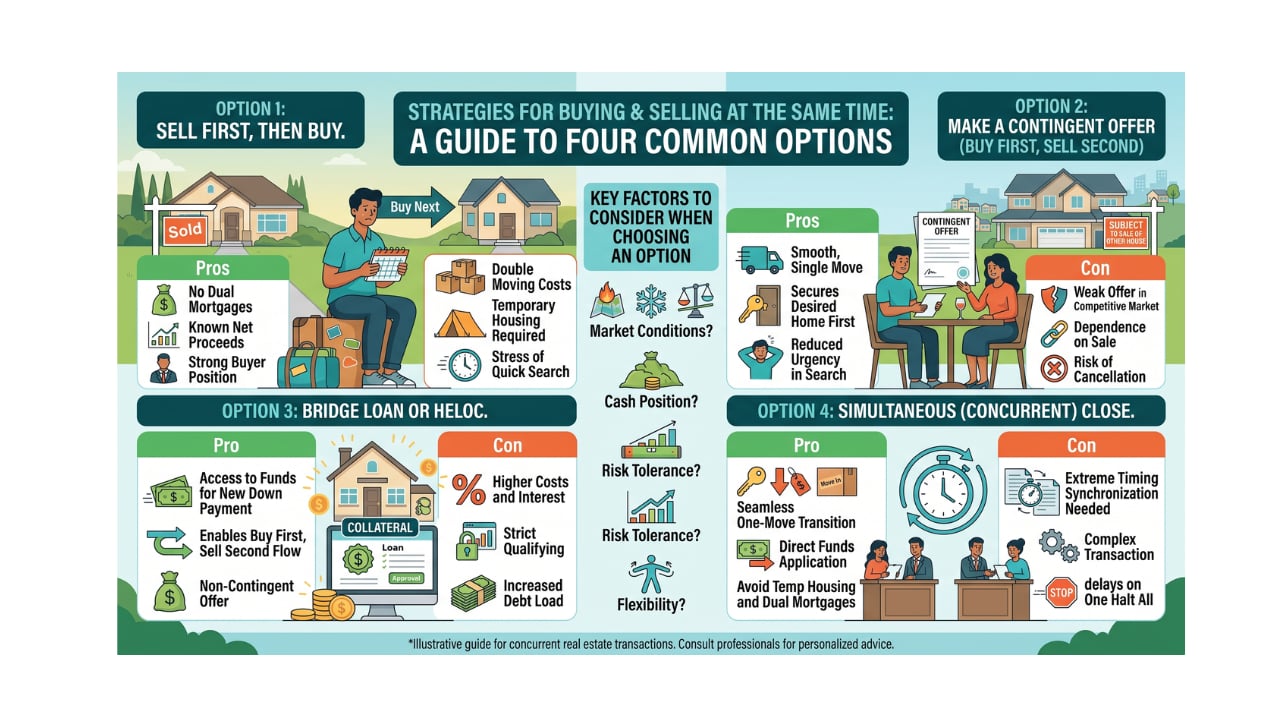
Most homeowners in Napa and Solano County need to do both — sell their current home and buy the next one — and the order matters. Selling first gives you maximum buying power and eliminates the risk of carrying two mortgages, but usually means moving twice or renting between transactions. Buying first keeps your timeline on your terms, but typically requires a bridge loan, a HELOC opened before you list, or a sale contingency that can weaken your offer in competitive markets. In today's market, the four main paths are: sell first, make a contingent offer, use bridge financing, or coordinate a simultaneous close — each with different costs and trade-offs depending on your equity, income, and local market conditions.
By Kasama Lee, REALTOR® | RE/MAX Gold | DRE #01408667 | July 26, 2026
If you own a home in American Canyon, Vallejo, Napa, Fairfield, or anywhere else in Napa or Solano County, chances are you're sitting with the same question every homeowner faces when it's time to move:
Do you sell first — and risk being between homes? Or do you buy first — and risk carrying two mortgages?
This is genuinely one of the most stressful decision points in real estate. And if you locked in a rate below 4% in 2020 or 2021, you're carrying an extra layer of anxiety: you know that swapping your current mortgage for a loan at today's rates — roughly 6.5 to 7% — will change your monthly payment significantly.
Here's what I've seen work for clients across southern Napa and Solano County, and how to think through each option honestly.
Why This Decision Is So Hard Right Now
Two forces are colliding for homeowners in this region right now.
First, equity. If you've owned your home in American Canyon or Vallejo for more than a few years, you're sitting on real wealth. American Canyon's median home value is approximately $700,000 — and many longtime owners have $300,000 or more in equity they could deploy as a down payment on the next home. That equity is your biggest financial lever in this transaction.
Second, rate lock. If your current mortgage is at 3% or 3.5%, moving to a new loan at today's rates is a meaningful monthly cost increase. That's often the real reason people hesitate — not the market, not the home, but the rate they'd be walking away from.
The thing is: your rate is only one piece of the equation. If your home no longer fits your life — if you need more space, less space, or a completely different location — optimizing for your mortgage rate at the expense of your actual quality of life may not be the right call. This is exactly the conversation more homeowners are having right now, and it's one I walk clients through regularly.
With that context, let's look at the four main ways to structure the move.
Your Four Options for Buying and Selling at the Same Time
Option 1: Sell First, Then Buy
This is the cleanest approach financially. You sell your current home, receive your equity in cash, and then search for and close on your next home as a fully approved buyer with a clear down payment and no competing obligations.
The downside: you may need to move twice — first into a rental or temporary housing, then into your next home. In the American Canyon and Vallejo market, where well-priced homes are selling in 26 to 57 days depending on the submarket, the gap between closing your sale and finding your next home can be shorter than many people expect. You won't necessarily be in temporary housing for months.
One practical tool that can shorten that gap: a rent-back agreement. When you sell, you negotiate a period — typically 30 to 60 days — where you remain in the home as a tenant after the buyers take title. You close, they own the home, but you keep your keys while you complete your home search. It's legal, it's common in California, and it buys you meaningful time without the cost of a hotel or a short-term lease.
For clients who want maximum negotiating power when they buy — no contingencies, clean pre-approval, cash-equivalent offer positioning — selling first is the strongest foundation.
Option 2: Make a Contingent Offer (Buy First, Sell Second)
A contingent offer means you make an offer on a new home with a clause stating that the purchase is contingent on selling your current home first. California's standard purchase agreement supports this with a home sale contingency period typically running 60 to 90 days.
The risk: sellers view contingent offers as weaker than non-contingent ones. If a better offer comes in during your contingency period, the seller can issue a kick-out notice — giving you 24 to 72 hours to either remove your contingency or step aside. If you haven't sold your home yet, stepping aside is your only realistic option.
Contingent offers work best in softer inventory environments. In Vallejo, where homes have been averaging closer to 57 days on market and median prices have eased to around $529,000, sellers are more open to accepting contingent offers rather than waiting indefinitely for a cleaner one. In tighter submarkets like Napa — where median prices are approaching $915,000 and well-priced homes can move in 21 days — contingent offers face more resistance.
If you're considering a contingent offer, your current home needs to be ready to go immediately: fully prepared, pre-inspected, and priced to sell quickly. The moment you have an accepted offer on your purchase, you need to list your current home that week — or sooner.
There's also a lesser-known tool sellers should know about: the Seller's Purchase of Replacement Property contingency (C.A.R. Form SPRP). If you're selling your current home but need time to find your next one before you commit to closing, this form lets you make your own sale contingent on successfully locating and contracting a replacement property within a set window (typically 17 days in the standard contract). It's not always popular with buyers, but in the right negotiation it can protect you from selling before you have somewhere to go.
Option 3: Bridge Loan or HELOC
For homeowners with significant equity, a bridge loan or home equity line of credit can fund the down payment on your next home before your current one sells — letting you buy without a sale contingency and without needing to sell first.
A HELOC is typically the lower-cost option. Rates currently run 7 to 9% variable, and a HELOC doesn't carry the origination costs of a bridge loan. The non-negotiable rule: open your HELOC before you list your home on the MLS. Once your property appears as active for sale, most lenders will freeze any existing line or decline to open a new one. If you think a HELOC might be part of your strategy, the conversation with your lender needs to happen now, before you do anything else.
A bridge loan is purpose-built for this transition. It provides short-term financing — usually 6 to 12 months — secured against your existing equity, and is specifically designed for homeowners navigating a buy-before-sell situation. Rates run higher than a HELOC, typically 8.99% per year and up, with closing costs of another 1 to 2 points. The carrying cost on a $300,000 bridge over six months is roughly $15,000 to $20,000. The advantage: bridge loan lenders understand the scenario and can often close in 8 to 21 business days — and some will work with you even after your home is listed.
In either case, the number your lender will scrutinize is your debt-to-income ratio. They'll count your existing mortgage, the HELOC or bridge loan payment, and your new purchase mortgage all at once. That combined monthly obligation has to fit within your qualifying DTI. Your lender can run this analysis before you commit to a path — and knowing whether you qualify changes everything about your strategy.
The equity most Napa and Solano County homeowners have built up is exactly what makes bridge financing a realistic option here — it's not a tool reserved for luxury buyers.
Option 4: Simultaneous (Concurrent) Close
The fourth option is to negotiate timelines so your sale closes on the same day — or within a day or two — of your purchase. Your sale proceeds fund your purchase at closing, without needing to hold bridge financing or carry two mortgages at all.
A concurrent close is achievable, but it requires tight coordination across every party: your buyer, your buyer's lender, the seller of your next home, and their lender — all moving on aligned timelines through the final two weeks. A delay from any one party can cascade across both transactions simultaneously.
I've helped clients execute concurrent closes successfully in this market. What makes it work: lenders who underwrite in-house and can fund quickly, a 45 to 60 day escrow window on both transactions to build in flexibility, and proactive daily communication with all parties in the final stretch. It requires more coordination than any other option, but when it works, it's the most financially efficient path — no bridge costs, no double move, no temporary housing.
What Actually Works in Today's Market
Here's the honest read on conditions across this region right now.
American Canyon's market remains competitive. Homes are moving in under 30 days in many price ranges, and new construction is adding inventory at multiple price points — KB Home's Watson Ranch communities are starting from the $590Ks, and Richmond American's newly opened Enclave at Canyon Estates brings premium homes from $1.9M framed by the Napa River and Sulphur Springs Mountain. More inventory options mean buyers have more to choose from, but well-located resale homes still move quickly.
Vallejo is moving at a slower pace — median days on market around 57 days — which creates genuine opportunity for contingent offers and seller negotiations. If you're trying to buy in Vallejo, you may find more sellers willing to accommodate your timeline.
Napa proper remains tighter, with homes still selling in three weeks at median prices approaching $915,000. Contingent offers face more headwinds there.
Regardless of which submarket you're navigating, your equity is your leverage. If you've built up $300,000 or more in your current home, that financial position opens up paths that simply aren't available to first-time buyers — whether you deploy it through bridge financing, a HELOC, or clean sale proceeds. The question isn't whether you have options. It's which combination of timing, cost, and risk fits your specific situation. That's exactly the kind of planning that should happen before a sign goes in the yard — not after.
Frequently Asked Questions
Can I make a contingent offer in a competitive market in Napa or Solano County?
Yes, but contingent offers put you at a disadvantage compared to non-contingent buyers. In softer markets like Vallejo, sellers are more likely to accept them. In tighter submarkets like American Canyon or Napa, you'll generally need a plan B — bridge financing or selling first — to compete effectively. Your agent's read on the specific seller's situation matters a lot here.
How much does a bridge loan cost in California?
Bridge loan rates in California typically run 8.99% per year or higher, with terms of 6 to 12 months. Closing costs add another 1 to 2 points. The total carrying cost on a $300,000 draw over six months is roughly $15,000 to $20,000. Whether that cost makes sense depends on what you're buying and how quickly your current home sells — it often does when the alternative is losing the home you want.
What is a HELOC and can I use it to buy before I sell?
A home equity line of credit (HELOC) lets you borrow against your existing equity at variable rates, currently around 7 to 9%. You can use those funds as a down payment before your current home sells. The critical rule in California: open your HELOC before your home appears on the MLS. Once you list, most lenders will freeze the line or refuse to open a new one.
What happens if I sell my home but can't find my next one in time?
You can negotiate a rent-back period — typically 30 to 60 days — in which you remain in the home as a tenant after the buyer takes title. This gives you breathing room to search without an immediate moving deadline. Alternatively, the Seller's Purchase of Replacement Property contingency (C.A.R. Form SPRP) lets you exit the sale if you can't secure a replacement property within the agreed timeframe — though not all buyers will accept it.
Do I need to sell my home before I can qualify for a new mortgage in California?
Not necessarily. If your debt-to-income ratio can support both your existing mortgage and a new one simultaneously, you may qualify to carry both temporarily. Your lender will calculate your combined DTI including both loan payments, any bridge loan or HELOC payment, and the new purchase payment. Many homeowners with significant equity and stable income can qualify — run the numbers with your lender before assuming you can't.
Timing your sale and purchase takes more coordination than either one alone — but it's something I help clients plan every week across American Canyon, Vallejo, Napa, Fairfield, and surrounding Napa and Solano County communities.
If you're approaching this from the seller side, the right place to start is a private listing consultation where we map out your timing, your net proceeds, and the most realistic path forward for your next move. If you're thinking through it as a buyer first, a buyer consultation will help you understand your financing options before you commit to a strategy.
Either way, let's talk through the numbers before you decide — schedule a no-pressure conversation at https://kasamasells.com/contact. If you'd like to start with your home's current value before we meet, you can also get a free home valuation at https://kasamasells.com/home-valuation.
About Kasama Lee, REALTOR®
Kasama Lee is a RE/MAX Gold Realtor® serving American Canyon, Napa, Vallejo, Fairfield, Benicia, Vacaville, and the broader Vallejo-Fairfield-Napa metro since 2004. A Best of Napa County 2024 award-winning team leader and certified real estate coach for Tom Ferry International, Kasama specializes in helping sellers and buyers navigate single-family homes, new construction, and 55+ active adult communities across southern Napa and Solano counties. With more than two decades of local market experience and a partnership with her husband Barton, a CPA, she brings both negotiation expertise and financial clarity to every transaction. Connect with Kasama at kasamasells.com.
Kasama Lee, REALTOR® | RE/MAX Gold | DRE #01408667