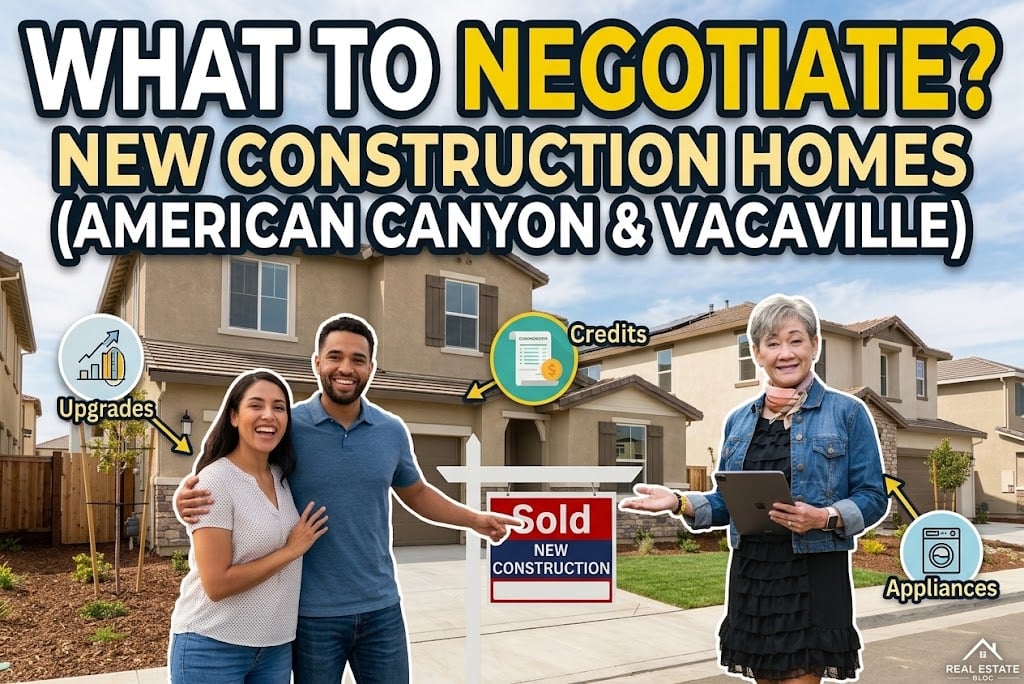
Production home builders in American Canyon — KB Home, D.R. Horton, and Richmond American — and the builders active in Vacaville rarely reduce their base price. It sets comparable sales for the entire community, and protecting those comps is worth more to them than shaving a few thousand off one deal. What builders do negotiate: design center upgrade credits, closing cost assistance, rate buydowns through their preferred lender, and lot premium reductions on spec homes (already built, sitting unsold). Your leverage is greatest on quick-move-in homes and near the end of a builder's fiscal quarter.
By Kasama Lee, REALTOR® | RE/MAX Gold | DRE #01408667 | August 23, 2026
How to Negotiate With a New Home Builder in American Canyon and Vacaville
When you walk into a new construction sales office at Watson Ranch in American Canyon — whether it's KB Home's Sorrel community starting in the $590Ks or their Serrano collection from $711,990, or D.R. Horton's Harvest neighborhood — you're in the builder's territory. The sales rep on the other side of the table works for the builder. Their job is to sell the home at the best price for the builder, not for you.
That doesn't mean you can't negotiate. It means you have to know what's actually on the table.
Here's what I walk every buyer through before they sit down and sign with a builder.
The One Thing Builders Almost Never Give You
Builders protect base prices the way sellers protect their comps. If KB Home cuts $25,000 off the base price of one home at Sorrel, every buyer in that community — and every appraiser writing up a future sale — now has a lower comparable. That's a pricing problem across the entire development.
So when you ask "can you lower the price?" the honest answer is almost always: not much, or not at all. But that's only the base price. The rest of the deal has a lot more room.
What Builders Will Actually Negotiate
Design center credits and upgrade packages. This is where builders have the most flexibility. A $15,000–$25,000 design center credit lets you choose upgraded flooring, countertops, appliances, or cabinetry — items the builder installs at their cost rather than the retail markup you'd pay if you upgraded after closing. At Watson Ranch and Enclave at Canyon Estates (Richmond American Homes, starting from $1.6M in American Canyon's eastern foothills), upgrade credits are one of the first things worth asking about.
Closing cost credits through the preferred lender. Builders typically have a preferred lender — either an in-house arm or a partner. They want you to use it because it gives them more control over the closing timeline. In exchange, many builders offer substantial closing cost credits — sometimes $10,000 to $20,000 or more — when you use their preferred lender. You should still get a competing mortgage quote. The credit may be worth taking; it may not. That calculation requires seeing both offers side by side, because the preferred lender's rate isn't always market rate.
Rate buydowns. With mortgage rates where they are in 2026, many builders are funding temporary 2-1 buydowns through their preferred lender. The way this works: your rate is 2% below the note rate in year one, 1% below in year two, then normalizes from year three onward. On a $650,000 loan, a builder-funded 2-1 buydown typically costs $10,000–$12,000 and can save you close to $450/month in year one. Compare that to a $10,000 price reduction, which translates to about $50/month in monthly payment savings. The buydown is almost always the more impactful offer — provided you're planning to stay long enough to see year three through.
Lot premium reductions on quick-move-in homes. A spec home — one the builder already constructed and is sitting on the books unsold — costs the builder money every day it isn't closed. Near the end of a fiscal quarter (builders typically track March, June, September, December closings for earnings purposes), their motivation to move standing inventory goes up. That's when lot premium credits or additional incentives become more realistic. In August 2026, American Canyon homes are spending a median of about 46 days on market. Any spec home approaching that mark is worth targeting.
Inclusions that don't affect comp pricing. Sometimes negotiating isn't about dollars. It's the refrigerator staying, window coverings installed, the garage door openers included, a landscaping allowance. These are lower-stakes asks builders agree to more readily — because they don't set a precedent in the comp record.
What Builders Won't Negotiate
Don't spend your leverage on these:
- Base price reductions — for the comps reason above. You might move it $2,000–$5,000 on a slow month, but rarely more.
- Lot switches after contract signing — once you've signed on a lot, that's your lot. Selection happens before the ink dries.
- The contract structure itself — builder contracts are not the CAR standard purchase agreement. The document is written by the builder's legal team, favors the builder, and is largely non-negotiable in its structure. Have your agent or a real estate attorney review it before signing.
- Construction deadline extensions — builders enforce their completion and close-of-escrow timelines. If your financing isn't ready when the home completes, you may face penalties or lose the home entirely. Get your financing squared away early.
The Vacaville New Construction Market
Watson Ranch and Enclave at Canyon Estates get a lot of attention, but Vacaville has eight active builders right now with communities spanning from the mid-$500Ks to over $1.1M. The same negotiating principles apply — upgrade credits and closing cost assistance are the primary tools builders use to compete for buyers. Vacaville's market is slightly less pressured than American Canyon right now, with a median sale price around $627K and homes moving in about 16 days.
If a spec home in Vacaville has been on the market 60 or more days, you have more room to push on incentives. The builder isn't going to drop the base price and set a bad comp — but they'll find other ways to make the deal work.
What the Watson Ranch Legal Situation Means for Current Buyers
As of June 2026, the Watson Ranch master plan developer filed a lawsuit against American Canyon over a proposed city boundary expansion — a dispute unrelated to the existing KB Home and D.R. Horton communities already under construction and actively selling. Buyers currently purchasing at Sorrel, Serrano, or Harvest at Watson Ranch are not directly affected by that litigation.
That said, Watson Ranch is a multi-phase development spanning more than 300 acres with over 1,200 homes planned. Not every future phase is guaranteed to proceed on the same timeline. If you're buying an early-phase home with expectations about what surrounding phases will look like in five or ten years — the town center, the parks, the broader neighborhood build-out — ask specific questions about the timeline of each phase and what's contractually guaranteed versus planned.
The Most Expensive Mistake New Construction Buyers Make
Signing without representation.
Builder sales reps are experienced. They sell homes every day in the same community, with the same contracts, using the same incentive structures. Most buyers sit across from them once. The knowledge gap is real.
In California, builder contracts almost always allow you to bring a buyer's agent — and since the industry-wide compensation structure changes that took effect in 2024, builders in this market typically pay the buyer's agent's fee directly. Your representation doesn't cost you anything extra. What it gets you: someone reviewing the contract, identifying what's actually negotiable in this specific community, and advocating for your interests rather than the builder's close-of-escrow timeline.
The catch that trips up buyers constantly: most builders require your agent to be registered on your first visit to the sales office. If you've toured the model homes without your agent present and haven't registered them, many builders will refuse to recognize that representation after the fact — even if you haven't signed anything. This is one of the most common and most expensive missteps I see new construction buyers make in our market.
Before you visit any model home at Watson Ranch, Enclave at Canyon Estates, or any Vacaville community, talk to your agent first. Even a quick call to register your representation before that first visit can protect you.
Frequently Asked Questions
Do I need my own agent when buying a new construction home in American Canyon or Vacaville?
You're not legally required to have your own agent, but it's strongly recommended. The builder's sales representative works for the builder — not for you. In California, most builders allow buyers to bring their own agent and pay that agent's compensation directly. The critical rule: your agent typically needs to be registered on your first visit to the sales office. Walking in alone — even just to look — may forfeit your ability to add representation later.
Will a builder lower the base price if I ask?
Rarely. Builders protect base prices because every sale sets comparable data for the whole community, affecting future appraisals and resale values. Instead, focus your negotiating energy where builders have flexibility: design center upgrade credits, closing cost assistance, rate buydowns through the preferred lender, and lot premium reductions on already-built spec homes.
Is it worth using the builder's preferred lender for the closing cost credit?
Sometimes — but only after you get a competing quote from an outside lender first. Builder lenders sometimes offer above-market rates that offset the credit value, and sometimes they're genuinely competitive. Compare the total cost of each loan over the expected hold period, not just the upfront credit amount. The math should drive the decision.
What is a 2-1 buydown, and should I ask for one from the builder?
A 2-1 buydown is a builder- or seller-funded incentive that reduces your mortgage rate by 2% in year one and 1% in year two, then returns to the note rate for the remaining loan term. On a $650,000 loan, this typically costs $10,000–$12,000 and saves roughly $450/month in year one — far more impactful than an equivalent price reduction. If a builder is offering one, it's generally worth taking, as long as you understand the rate resets in year three and plan accordingly.
What's the difference between a spec home and a to-be-built home?
A spec home (also called a quick-move-in) is a home the builder has already constructed without a specific buyer under contract — they built it speculatively. A to-be-built home is chosen from a floor plan and constructed after you sign. Spec homes offer faster closing (typically 60–90 days vs. 9–12 months for to-be-built) and more room to negotiate on incentives, because a finished, unsold home costs the builder money every day it sits.
Ready to Buy New Construction? Here's How to Protect Yourself
Buying new construction in American Canyon or Vacaville can be a smart move — modern systems, energy efficiency, warranties, and a home designed for today's lifestyle. But the process is different from buying a resale, and the contract you sign is not the same one you'd see in a standard California transaction.
Before you visit any sales office, let's talk. I work with buyers across Watson Ranch, Enclave at Canyon Estates, and Vacaville communities regularly — I know what each builder's current incentives look like, what's actually negotiable, and what questions to ask before you commit.
If you're navigating this in your own home search, I'd love to talk it through with you in a private, confidential buyer consultation. We can map out your goals, financing readiness, and the best path forward in today's market — no pressure, just a real conversation. Schedule a consultation at https://kasamasells.com/contact.
About Kasama Lee, REALTOR®
Kasama Lee is a RE/MAX Gold Realtor® serving American Canyon, Napa, Vallejo, Fairfield, Benicia, Suisun City, and the broader Vallejo-Fairfield-Napa metro since 2004. A Best of Napa County 2024 award-winning team leader and certified real estate coach for Tom Ferry International, Kasama specializes in helping sellers and buyers navigate single-family homes, new construction, and 55+ active adult communities across southern Napa and Solano counties. With more than two decades of local market experience and a partnership with her husband Barton, a CPA, she brings both negotiation expertise and financial clarity to every transaction. Connect with Kasama at kasamasells.com.
Kasama Lee, REALTOR® | RE/MAX Gold | DRE #01408667