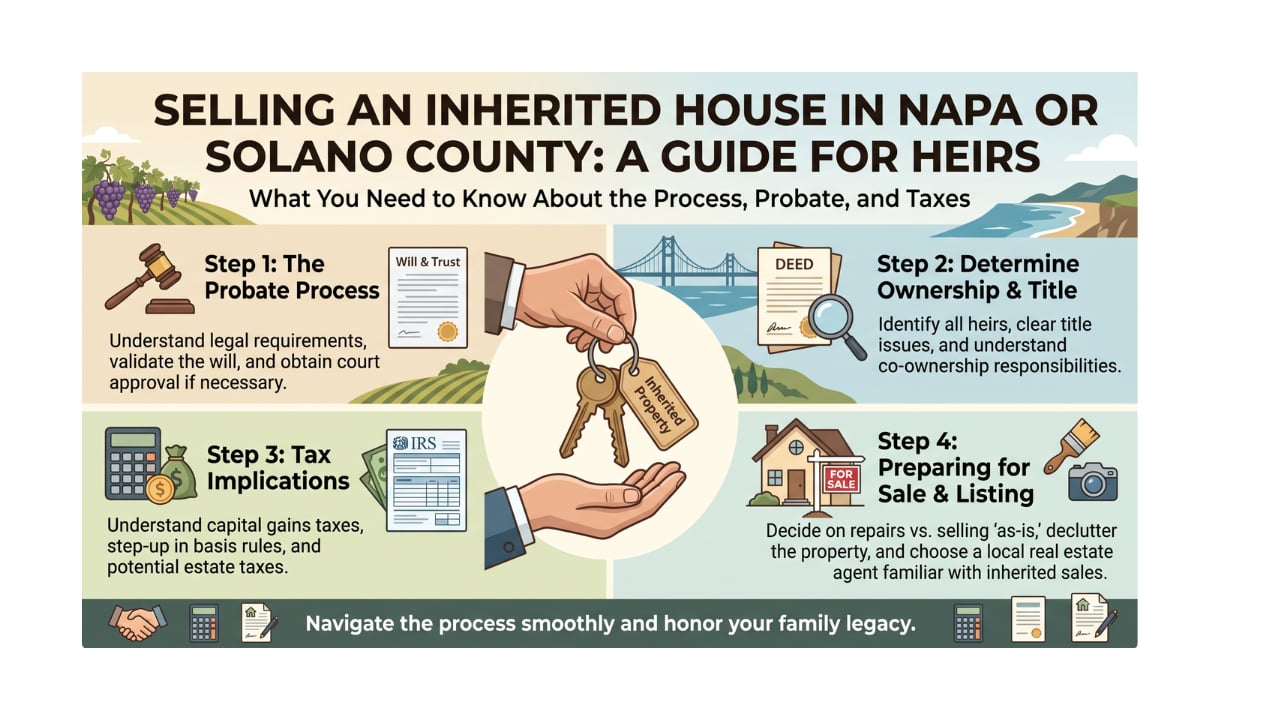
What do you do when you inherit a house in California?
When you inherit a house in California, the IRS resets the property's cost basis to its fair market value on the date of death — erasing all of your parents' accumulated appreciation for capital gains purposes. Whether you can sell quickly or need to go through probate depends on how the property was titled: a home in a living trust can close in 30 days; a home that must go through probate typically takes 12–18 months. Under Proposition 19, you must occupy the home as your primary residence within 12 months to avoid a full property tax reassessment to current market value.
By Kasama Lee, REALTOR® | RE/MAX Gold | DRE #01408667 | July 5, 2026
Selling an Inherited House in Napa or Solano County: What Heirs Need to Know
When a parent or family member passes away and leaves you a home in Napa or Solano County, you're suddenly making some of the most consequential financial decisions of your life — often while grieving, often under time pressure, and often without a clear picture of your options.
I walk heirs through this situation regularly. The first thing I tell them: the worst outcomes happen when people wait too long, or when they assume they have more time than they do. Here's what you need to understand before you make any decisions.
The Tax Benefit Most Heirs Don't Know About
The step-up in basis is one of the most valuable features of inheriting real estate — and most heirs don't know it exists.
Here's how it works: when your parent bought their American Canyon or Napa home decades ago for $180,000, and it's now worth $750,000, the IRS does not require you to pay capital gains tax on that $570,000 of appreciation. Your cost basis — the starting point for any capital gains calculation — resets to the fair market value on the date of death.
If you sell soon after inheriting, you may owe little to nothing in capital gains. That's true even if the property appreciated significantly over the last 20 or 30 years.
This applies whether the home was held in a trust, transferred through probate, or passed via a transfer-on-death deed. The step-up in basis is a federal income tax rule — separate from California property tax rules. Two different systems, two different sets of rules.
California has no state inheritance tax and no state estate tax. For estates under the 2026 federal exemption of $15 million per individual, federal estate tax won't apply either. What you will face is the capital gains question if you sell — and the property tax question the moment you inherit. If you want to dig deeper into the capital gains side for long-held California homes, I covered the Section 121 exclusion and California capital gains rules here.
Trust vs. Probate: Why This Decision Changes Everything
How quickly you can sell an inherited home — and how much it costs you in the process — depends almost entirely on how the property was titled when your family member died.
If the home was in a living trust: You step in as successor trustee, record an Affidavit of Death with the county recorder, and you can proceed with selling or managing the property immediately. A 30-day escrow close is entirely realistic. Some trust sales close in ten days when circumstances call for it. Trust administration typically runs 1–2% of the property value in attorney, CPA, and trustee fees.
If the home was in the decedent's name only: You're looking at probate — a court-supervised process that takes 12 to 18 months in California, and up to 2 to 4 years for complex estates. Probate costs run 4 to 8% of the gross estate value and include statutory attorney fees, executor compensation, and court costs. You can begin marketing the home once the executor receives Letters Testamentary from the court (typically 6–8 weeks in), but the actual sale usually requires a court confirmation hearing — adding another 30 to 60 days to the timeline.
One note worth knowing: California updated its probate law effective April 1, 2025, creating a faster path for many families. Primary residences valued under $750,000 can now transfer to heirs via an expedited petition process in approximately 2–6 months without full probate. Given where American Canyon and many Vallejo homes are priced, check with a probate attorney whether your situation qualifies.
If the home was held in joint tenancy with right of survivorship — common between spouses — the surviving owner already has full title and can sell without probate. The surviving spouse also benefits from California's community property step-up: both halves of the property get a stepped-up basis at death, which is more favorable than joint tenancy treatment in other states.
What Proposition 19 Means for Heirs
Prop 19 changed the rules for inherited property significantly starting February 16, 2021. If you inherited before that date, the old rules may apply — talk to a tax attorney. Here's what heirs in 2026 need to know:
The exclusion is limited. Prop 19 preserved a parent-to-child exclusion from property tax reassessment, but only for one specific scenario: the parent's primary residence, transferred to a child who also makes it their primary residence within 12 months of the transfer.
If you don't move in: The county assessor reassesses the property to current market value immediately — on the date of transfer. The Prop 13 protection your parent carried disappears. On a $750,000 home in Napa County (where the effective property tax rate is approximately 1.28%), that's roughly $9,600 per year in property taxes, versus the much lower bill your parent may have been paying on a Prop 13 base established 20 or 30 years ago. The difference can run $4,000–$7,000 per year, every year you hold it.
If the property was a rental or vacation home: No exclusion, regardless of what the child does with it afterward. Full reassessment happens automatically.
The value cap: Even if you qualify for the exclusion (you move in within 12 months), there's a limit. The exclusion only applies up to $1,044,586 above your parent's factored base year value. Homes with significant appreciation in excess of that threshold will see partial reassessment.
A note for clarity: the Prop 19 provision I wrote about for homeowners 55 and older — how they can transfer their tax base when they buy a new home — is a different provision for a different situation. That's for sellers preserving their tax base when moving. The parent-child exclusion described here is about heirs keeping a parent's tax base on an inherited property. Same ballot measure, very different rules.
Sell, Keep, or Rent? Running the Real Math
The decision to sell, keep, or rent an inherited home should be driven by the numbers — not by guilt, sentiment, or assumptions about what your parent would have wanted.
Here's the honest math most heirs don't run:
If you sell: You'll benefit from the step-up in basis, likely owe minimal capital gains, pay probate or trust administration costs (if not already resolved), and walk away with your share of the net proceeds. Working with an experienced listing agent who coordinates with probate attorneys and estate vendors makes a real difference — both on timeline and on sale price.
If you keep and move in: You'll qualify for the Prop 19 exclusion (preserving the lower tax base), and you may be able to use the step-up basis if you sell later. But selling later means any future appreciation is taxable from your new inherited basis.
If you keep and rent: You're likely looking at full property tax reassessment (since you're not occupying it), a new tax bill that significantly reduces rental income, California landlord-tenant law compliance under AB 1482 (including just-cause eviction requirements for tenants in place 12+ months), and ongoing maintenance and management costs. Some heirs find rental income pencils out clearly. Others find that after reassessment and the carrying costs of being a landlord, the math no longer works.
I've seen heirs hold on to a home for emotional reasons, only to find that the carrying costs and management burden outweigh any financial benefit — and that the home was in better condition to sell right after inheriting than it was two or three years later. There's no universal right answer, but you need real numbers before you decide.
One more thing to plan for: a change of ownership triggers a supplemental property tax bill that arrives separately from your regular tax bill — typically 3 to 9 months after the transfer. It's not included in escrow and it's not paid by the estate. It comes directly to you, reflecting the difference between the old assessed value and the new one. If you're unfamiliar with how California supplemental tax bills work, I've broken down exactly how they're calculated for Napa and Solano County here.
A note on getting the right help: California inheritance law, Proposition 19, and federal capital gains tax all intersect here. Mistakes are expensive and often irreversible. Work with a CPA and a California estate or probate attorney before making any final decision. What I can do is give you the real estate side of the analysis — the current market value of the home, what comparable properties are selling for in American Canyon, Napa, or Vallejo, and what your net proceeds would realistically look like.
Frequently Asked Questions
Do I owe capital gains tax when I sell an inherited house in California?
Usually very little, and often none — if you sell shortly after inheriting. The step-up in basis resets your cost basis to the fair market value on the date of death, erasing all of your parent's accumulated appreciation. You'd only owe capital gains on appreciation that occurred between the date of death and the date of sale. California treats capital gains as ordinary income, so consult a CPA about your specific situation.
How long does it take to sell a house that has to go through probate in California?
Typically 12 to 18 months from the date of death, though simpler estates can move faster under the updated law effective April 1, 2025, which allows primary residences under $750,000 to transfer via an expedited 2–6 month process. If the home needs full probate and a court confirmation of the sale, add 30 to 60 days to the timeline after the executor is appointed.
Does Proposition 19 affect inherited homes in Napa and Solano Counties?
Yes. Under Prop 19, you must establish the inherited home as your primary residence within 12 months of the transfer to avoid a full property tax reassessment. If you don't move in — or if the property was a rental or vacation home — the county assessor reassesses the property to current market value immediately. In Napa County, where the effective property tax rate is approximately 1.28%, that can mean thousands of dollars per year in additional taxes.
Can I sell an inherited home if it's still in probate?
You can begin marketing and accept an offer, but the sale typically requires court confirmation — a separate hearing that adds 30 to 60 days to the process. Your probate attorney can petition the court for authority to sell. If the home was in a trust, you skip probate entirely and can close much faster.
Does inheriting a house affect my supplemental property tax bill?
Yes. A change of ownership — including inheritance — triggers a property tax reassessment and a supplemental tax bill. If the Prop 19 exclusion applies (you're moving in as your primary residence), reassessment is limited. If not, expect a supplemental bill reflecting the difference between your parent's assessed value and today's market value. That bill typically arrives 3 to 9 months after the transfer, and it's not included in escrow — it comes directly to you.
If you've inherited a home in American Canyon, Napa, Vallejo, Fairfield, Benicia, or anywhere in southern Napa or Solano County, the decisions you make in the first few months — about probate vs. trust timelines, the Prop 19 occupancy deadline, and whether to sell, keep, or rent — have real and lasting financial consequences.
I've helped many families navigate this. My husband Barton is a CPA, so together we bring both the real estate and the financial lens to the conversation. If you're trying to figure out what the home is worth, what your net proceeds would look like, or whether this is the right time to sell, I'd love to walk through it with you.
If you're thinking through this for your own family's situation, I'd love to walk you through the numbers in a private, no-pressure listing consultation. We can talk through the specifics of your home and timeline — no commitment, just clarity. Schedule a conversation here.
Not quite ready for a full conversation? You can start with a free home valuation to get a current estimate of what the home is worth in today's market.
About Kasama Lee, REALTOR®
Kasama Lee is a RE/MAX Gold Realtor® serving American Canyon, Napa, Vallejo, Fairfield, Benicia, Suisun City, and the broader Vallejo-Fairfield-Napa metro since 2004. A Best of Napa County 2024 award-winning team leader and certified real estate coach for Tom Ferry International, Kasama specializes in helping sellers and buyers navigate single-family homes, new construction, and 55+ active adult communities across southern Napa and Solano counties. With more than two decades of local market experience and a partnership with her husband Barton, a CPA, she brings both negotiation expertise and financial clarity to every transaction. Connect with Kasama at kasamasells.com.
Kasama Lee, REALTOR® | RE/MAX Gold | DRE #01408667