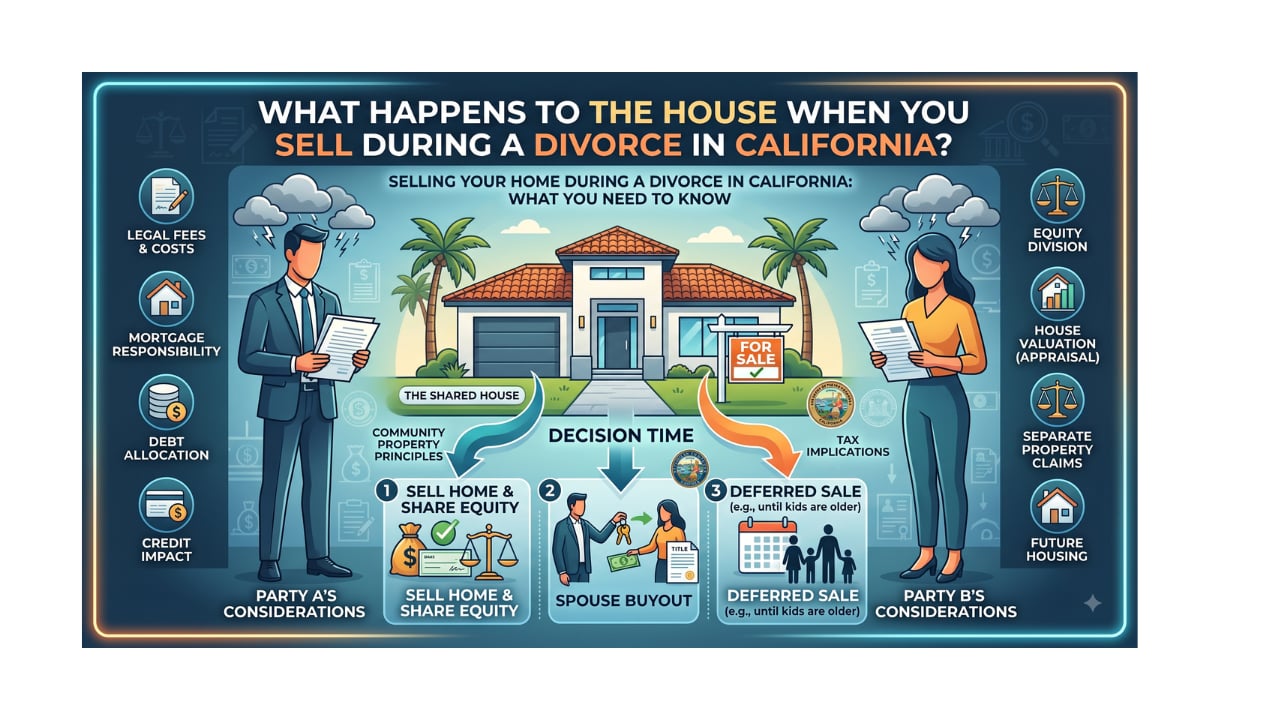
What Happens to the House When You Sell During a Divorce in California?
In a California divorce, the family home is community property — meaning both spouses own it equally regardless of whose name is on the deed. Net proceeds from a sale are split 50/50 under California Family Code Section 2550. But the bigger issue for most couples is timing: selling while you're still legally married allows a couple to exclude up to $500,000 in capital gains from federal taxes. Wait until after the divorce is final, and that exclusion drops to $250,000 per spouse. For longtime homeowners in Napa or Solano County, that difference can exceed $83,000 in taxes.
By Kasama Lee, REALTOR® | RE/MAX Gold | DRE #01408667 | July 19, 2026
Selling Your Home During a Divorce in California: What You Need to Know
Your home is probably your largest asset. When a marriage ends, what happens to it — and when — shapes how much you walk away with.
This isn't legal advice, and I'd always recommend working with a California family law attorney alongside your real estate agent. But after twenty-plus years of helping clients in American Canyon, Napa, Vallejo, Fairfield, Benicia, and surrounding communities navigate the sale of a home during divorce, there are a few things I know matter most.
Here's how the process actually works.
California Is a Community Property State — And That Changes Everything
California is one of nine community property states. If you purchased your home during the marriage, it's community property — even if only one spouse's name is on the title, and even if only one spouse made the mortgage payments.
That means the equity belongs equally to both of you.
When divorce is on the table, you have four main paths for the family home:
- Sell it and split the proceeds 50/50. This is the most straightforward option and the one most courts default to when neither spouse can afford to buy out the other.
- One spouse buys out the other. The staying spouse pays the departing spouse 50% of the equity, typically through a refinance. At today's rates, that's a calculation worth doing carefully before committing.
- Deferred sale. A judge can order the home kept for a defined period under specific circumstances — this requires a court hearing and approval, and it's less common than it used to be.
- Court-ordered sale. If both spouses can't reach agreement on any of the above, either party can petition the court to order the home listed and sold — with or without the other spouse's cooperation.
In my experience, the cleanest path is an agreed-upon sale. The alternatives — buyouts requiring refinancing at today's rates, or court-ordered sales with an appointed referee — tend to take longer, cost more, and create more friction in an already difficult situation.
The Tax Deadline Most Divorcing Homeowners Miss
If your home has appreciated significantly — which is true for most Napa and Solano County owners who bought more than five years ago — capital gains taxes deserve serious attention before you decide when to sell.
Here's the rule under IRC §121:
- Married and selling together: You can exclude up to $500,000 of capital gains from federal income tax, as long as you've owned and lived in the home as your primary residence for at least two of the last five years.
- Divorced and selling as individuals: Each ex-spouse can exclude only up to $250,000 of their share of the gain.
The critical factor is your legal marital status on December 31 of the year the home sells. If the home closes in 2026 and your divorce is final before December 31, 2026, you file as single — and each of you is limited to the $250,000 per-person exclusion.
What does this mean in real numbers?
Consider a couple in American Canyon who bought their home in 2012 for $380,000. Today, it's worth around $720,000. That's $340,000 in gain — comfortably within the $500,000 married exclusion, and also within $250,000 each as individuals if they sell after the divorce. They have timing flexibility.
Now consider a couple in Napa who bought in 2005 for $650,000, and the home is now worth $1,400,000. That's $750,000 in gain. Married and selling together, they'd exclude $500,000 and owe tax on $250,000. Divorced and filing individually, each spouse would exclude $250,000 of their $375,000 share — and owe tax on $125,000 each. The difference in federal capital gains taxes alone can exceed $83,000, depending on their bracket. California also taxes capital gains as ordinary income, which compounds the gap further.
There's a lesser-known provision worth knowing about. Under Treasury Regulation 1.121-1(c)(3)(i), if a divorce decree or legal separation agreement explicitly gives one spouse the right to remain in the home, the other spouse is treated as still using the property as their principal residence during that period. A spouse who moved out can count the years their former partner lived there toward the two-of-five-year use requirement — preserving their eligibility for the exclusion. The decree must explicitly grant this right, and your CPA and attorney need to align on this before you rely on it.
For a deeper look at how the Section 121 exclusion works for California sellers — including what counts toward your basis, partial exclusions, and how California taxes the gain — this post on capital gains tax for Napa and Solano County sellers covers it in detail.
How to Actually Sell the House (When It's Complicated)
This is where transactions break down — not on the legal or tax side, but on the operational reality of getting the home prepared, priced, listed, and sold when two people aren't always in agreement.
Agent selection. Both spouses must agree on a listing agent. The cleanest path: a neutral agent that neither spouse brought to the table independently, and that neither feels is "their" agent. When I take on a divorce sale, I'm not representing one side. I'm representing the property and both co-sellers with the same goal — maximum proceeds, minimum conflict.
Listing price. California courts can order a sale if spouses can't agree to proceed. They can also appoint a neutral referee if the parties can't align on listing price or agent. That referee has court authority to confirm the agent, review the market analysis, approve the price, and sign offers on behalf of both parties. The cost: $5,000 to $15,000 in referee fees, plus 30 to 60 additional days. A certified appraisal and a candid conversation between the attorneys almost always gets the parties to a number faster — and for a fraction of that cost. I'd always recommend trying that route first.
Signing documents. Both spouses must sign all listing agreements, purchase contracts, and closing documents — even if one spouse is resisting. If a spouse is actively refusing to cooperate, your family law attorney can seek a court order compelling their participation. This is more common than people expect, and it doesn't have to derail the timeline if your team is prepared for it.
Closing proceeds. The escrow company splits the net proceeds between both parties at closing according to the written agreement or court order. Neither party controls where the money goes — the escrow officer handles the disbursements directly. For buyers and sellers in California, title and escrow are handled jointly by a title and escrow company, which also ensures that any remaining mortgage, transfer taxes, and costs are paid before proceeds are distributed.
A well-prepared listing matters more in a divorce sale than in almost any other situation. When both co-sellers are motivated to close quickly and cleanly, the right preparation — accurate pricing, thoughtful presentation, and full compliance with California's disclosure requirements — maximizes what both parties walk away with. California's required seller disclosure package includes the Transfer Disclosure Statement, Seller Property Questionnaire, Natural Hazard Disclosure, and several newer forms that took effect in 2026. These apply to your sale regardless of the personal circumstances behind it.
And when you're ready to run the actual numbers — what you'll net after agent commissions, documentary transfer taxes (and in Vallejo, the additional city transfer tax), and escrow and title fees — that's a conversation I have with every seller before we price the home. Every market and every situation is different, but knowing your number before you list is always worth the time.
Selling a home during divorce requires getting three things right: timing (for the tax implications), coordination (for the transaction itself), and preparation (for maximum proceeds). Getting your real estate agent, family law attorney, and CPA aligned early prevents the costly delays and surprises that often slow these sales down — or derail them entirely.
Frequently Asked Questions
Does it matter whose name is on the mortgage when divorcing in California?
In California, it doesn't matter whose name is on the title or mortgage for community property purposes. If the home was purchased during the marriage, both spouses own it equally. The legal obligation of the mortgage stays with whoever signed the note, but the equity is divided equally between both parties in the divorce.
Can one spouse force the other to sell the family home in a California divorce?
Yes. Under California Family Code, either spouse can petition the court to order a sale of the family home. The court can also appoint a neutral referee to manage the sale if both spouses are unable to cooperate on agent selection or listing price. Courts generally prefer a voluntary, agreed-upon sale, but a forced sale is available as a remedy when cooperation breaks down completely.
What if the home appreciation exceeds $500,000 — will I owe capital gains taxes?
If your capital gain exceeds the exclusion amount — $500,000 for a married couple selling together, or $250,000 per person after the divorce is final — the overage is subject to federal capital gains tax. California also taxes capital gains as ordinary income. For high-equity homeowners in Napa County, where a home purchased in 2005 might have appreciated by $700,000 or more, this is a real calculation worth running with a CPA before deciding on timing.
How long does selling a home during divorce in California typically take?
The timeline from agreement to close typically runs 3–6 months: 2–4 weeks to prepare and list, 37–49 days on market on average, and 30–45 days in escrow. If the parties can't agree on agent or price and a court referee is needed, add 30–60 additional days and $5,000–$15,000 in referee costs. The sooner both parties align, the faster and more cost-efficiently the home sells.
Do I need a special type of real estate agent for a divorce home sale in California?
You don't need a formal certification, but you do need an agent who understands the co-seller dynamic — communicating clearly with both parties, coordinating with both attorneys, and keeping the transaction moving without taking sides. A neutral agent with experience in this type of sale prevents conflict from slowing or derailing the process, and often helps both parties get to a listing price more quickly than going back to court.
Navigating a divorce home sale means getting the timing right, the pricing right, and the coordination right — all while managing a process that's already stressful by nature.
If you're thinking through this for your own home, I'd love to walk you through the numbers in a private, no-pressure listing consultation. We can talk pricing, timing, and what your specific home looks like in today's market — no commitment, just clarity. Schedule a conversation here.
Not quite ready for a full conversation? You can start with a free home valuation to get a current estimate of your home's value in today's market.
About Kasama Lee, REALTOR®
Kasama Lee is a RE/MAX Gold Realtor® serving American Canyon, Napa, Vallejo, Fairfield, Benicia, Suisun City, and the broader Vallejo-Fairfield-Napa metro since 2004. A Best of Napa County 2024 award-winning team leader and certified real estate coach for Tom Ferry International, Kasama specializes in helping sellers and buyers navigate single-family homes, new construction, and 55+ active adult communities across southern Napa and Solano counties. With more than two decades of local market experience and a partnership with her husband Barton, a CPA, she brings both negotiation expertise and financial clarity to every transaction. Connect with Kasama at kasamasells.com.
Kasama Lee, REALTOR® | RE/MAX Gold | DRE #01408667