What do California home sellers have to disclose?
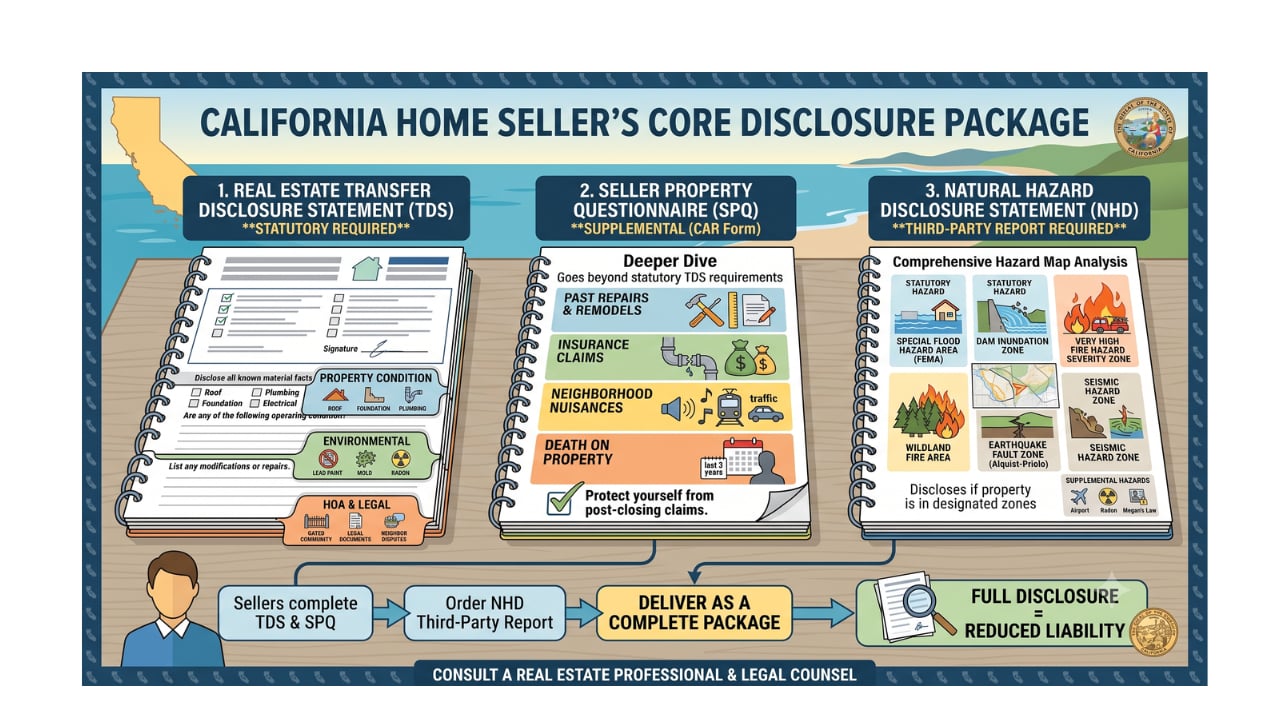
California home sellers must complete a Transfer Disclosure Statement (TDS), Seller Property Questionnaire (SPQ), and Natural Hazard Disclosure (NHD) for most residential sales of 1–4 units. In 2026, three additional disclosures apply: AB 455 requires sellers to disclose any known tobacco or nicotine residue history, SB 382 requires an electrical system advisory, and enhanced AB 38 rules apply to pre-2010 homes in designated fire hazard zones. California law requires sellers to disclose what they personally know — you are not required to inspect or investigate — but knowingly withholding a material defect creates significant legal liability that survives the closing for three years.
By Kasama Lee, REALTOR® | RE/MAX Gold | DRE #01408667 | June 21, 2026
One of the most common questions I get from homeowners in American Canyon, Napa, Vallejo, and Fairfield who are thinking about selling: "What am I actually required to tell the buyer?"
It's a fair question — and one that makes a lot of sellers genuinely anxious. You don't want to hand the buyer ammunition to renegotiate everything. But you also don't want to miss something legally required and find yourself on the wrong end of a lawsuit two years after you've moved on.
Here's the full picture of what California law requires you to disclose in 2026, including three new laws that took effect at the start of this year.
The Core Disclosure Package: TDS, SPQ, and NHD
Every residential sale of 1–4 units in California requires these three forms. Think of them as your baseline — the minimum the law expects before a buyer can close on your home.
Transfer Disclosure Statement (TDS)
This is the foundation of your disclosure package, required under California Civil Code §1102. You fill it out yourself. Your agent can help you understand what's being asked, but cannot complete it on your behalf — that's the law.
The TDS covers:
- Structural condition — roof, foundation, walls, windows, and any additions or alterations
- Systems and appliances — what's included in the sale and whether each item is operational
- Known environmental hazards — mold, asbestos, lead paint, radon, fuel storage tanks
- Unpermitted work — room additions or remodels done without permits or not up to code
- Deaths on the property — any death that occurred within the past three years (cause of death is generally not disclosed)
- Neighborhood nuisances or disputes — anything that would materially affect the buyer's use or enjoyment
- Required safety features — smoke detectors, carbon monoxide detectors, and water heater bracing are required by California law to be in place at closing
The key phrase throughout the TDS is what you know. California law requires disclosure of known material defects — not discovery. You are not required to hire a home inspector or dig behind walls looking for problems. But if you know something affects the property's value or desirability, it belongs on this form.
Seller Property Questionnaire (SPQ)
The SPQ isn't required by state statute on its own, but if your transaction uses a California Association of Realtors purchase contract — which most do — the contract requires it. The SPQ goes deeper than the TDS, asking about insurance claims you've filed, legal disputes involving the property, HOA violations, any shared fences or driveways with disputes, and anything else affecting the property that a buyer would reasonably want to know.
Natural Hazard Disclosure (NHD)
This one is ordered from a third-party provider — not something you fill out yourself. The NHD report ($50–$150) identifies whether your property is in any of six state-designated hazard zones:
- Special Flood Hazard Area
- Dam Inundation Zone
- Very High Fire Hazard Severity Zone
- Wildland Fire Area
- Earthquake Fault Zone
- Seismic Hazard Zone (liquefaction or landslide risk)
In parts of southern Napa County and Solano County — particularly foothill and hillside properties — fire zone and seismic zone designations come up regularly. Your escrow or title company can order the NHD report on your behalf. It gets delivered to buyers alongside the TDS.
The 2026 Updates: Three New Disclosure Requirements
California added three significant new disclosure requirements effective in 2026. If your agent hasn't walked you through all three, ask.
AB 455 — Tobacco and Nicotine Residue
Effective January 1, 2026, California became the first state in the country to classify thirdhand smoke — the chemical residue left behind after regular indoor smoking — as an environmental hazard on par with lead paint or asbestos. Under AB 455, if you have actual knowledge that tobacco or nicotine products (including e-cigarettes and vaping devices) were smoked inside your home, or that the property has nicotine residue, you must disclose it in writing.
This isn't about a single cigarette smoked on the back porch years ago. The law targets properties where smoking was a regular indoor occurrence — residue that has settled into walls, carpets, insulation, and HVAC systems. If you purchased the house knowing prior owners smoked indoors, that's disclosable. If you smoked inside yourself, that's disclosable. If you don't have actual knowledge of any smoking history, you're not required to investigate.
SB 382 — Electrical System Advisory
Effective January 1, 2026, sellers of single-family homes must provide buyers with a written advisory recommending a professional inspection of the home's electrical systems — the main service panel, subpanels, and wiring. The advisory also notes that substandard, recalled, or faulty wiring can create fire risk and may make it harder to obtain homeowner's insurance.
That last point matters in the current California market. Insurers have been scrutinizing electrical panels closely — particularly older Federal Pacific or Zinsco panels, or homes with aluminum wiring. If your home has an aging panel, expect buyers to order an electrical inspection after receiving the SB 382 advisory. This doesn't mean you need to replace or upgrade anything before listing. SB 382 is a disclosure and advisory requirement, not a repair mandate. But it does create a moment where informed buyers may ask for credits or repairs based on what an inspector finds. You can read more about why insurance costs are factoring more heavily into California real estate transactions and how to plan for it.
AB 38 — Enhanced Fire Hardening Disclosure
If your home was built before January 1, 2010 and is located in a High or Very High Fire Hazard Severity Zone as designated by CalFire, you now must disclose whether your property meets 12 specific home-hardening conditions. These include the type of roofing material, vent screening, window glazing type, vegetation clearance within five feet of the structure, and more.
You must also provide buyers with the State Fire Marshal's Low-Cost Retrofit List — a guide to affordable fire-hardening improvements buyers can make after they move in. If your home isn't in a designated fire hazard zone, the enhanced AB 38 requirements don't apply. Your NHD report will tell you exactly which zone your property falls in.
Timing: When Do Disclosures Get Delivered?
California law requires disclosures to be delivered "as soon as practicable" — but the custom in Northern California, including Napa and Solano Counties, is to complete the disclosure package before you go on the market. Buyers review the full disclosure package before writing an offer.
This approach protects you. Buyers who see your disclosures upfront can factor everything into their offer price. You avoid the scenario where a buyer is deep in escrow, already emotionally invested, and then discovers something in the disclosures that derails the transaction. I've watched that play out, and it's expensive for everyone involved.
Under California law, once the buyer receives disclosures, they have 3 days to cancel if delivered in person, or 5 days if delivered electronically or by mail. During that window, they can walk for any reason without penalty. After the window closes, cancellation requires pointing to a specific contingency in the purchase contract.
What Happens If You Miss a Required Disclosure
This is the part sellers worry about most — and it's worth taking seriously.
Failure to disclose a known material defect is classified as fraud under California law. Buyers have a three-year statute of limitations from close of escrow to pursue legal action. Successful claims can result in payment of repair costs, diminished property value, and — in cases where concealment was intentional — punitive damages.
Buyers who discover incomplete disclosures before closing also have the right to cancel the purchase agreement without forfeiting their deposit. A fallen-out deal in 2026 — carrying costs, relisting fees, reduced buyer demand for a property that was previously in escrow — often costs far more than whatever the seller was trying to avoid disclosing.
The more common scenario isn't bad-faith sellers hiding major defects. It's sellers who simply didn't realize something was disclosable, or who weren't walked through the forms carefully. That's why working through every section of the TDS and SPQ with an experienced listing agent — not rushing through it the night before you list — makes a real difference. Understanding what you'll net after all closing costs and commissions is part of the same preparation; the full cost picture for sellers in Napa County and Solano County, where customs differ on who pays escrow and title, matters before you decide to move forward. You can also find it useful to understand why buyers walk away and how to get ahead of the issues that come up at inspection — many of which are also disclosable.
Your best protection as a seller is to disclose what you know, completely and honestly. California courts are clear that disclosure obligations attach to actual knowledge — not assumed knowledge. A seller who works through the forms carefully and honestly, with an agent who knows the local disclosure customs for Napa and Solano Counties, is well-protected.
Every home is different, and what your specific disclosure package looks like depends on your property — its age, construction type, location, and history. That's exactly the kind of conversation I have with every seller before we list, not after.
Frequently Asked Questions
Do I have to disclose if someone died in my house in California?
Yes — if a death occurred on the property within the past three years, you must disclose it in the Transfer Disclosure Statement. The cause of death does not need to be disclosed (and deaths related to AIDS cannot be disclosed under California law). Deaths that occurred more than three years ago are not required to be disclosed, though you should not actively conceal them if a buyer asks directly.
Do I have to fix problems I disclose on the TDS before selling?
No. Disclosure is not the same as repair. You're required to tell buyers what you know — you're not required to fix it before selling. Buyers may use disclosed information to negotiate repairs, credits, or a lower price, but disclosure itself creates no repair obligation. The exception: California law requires smoke detectors, carbon monoxide detectors, and water heater bracing to be in place at close of escrow.
Who pays for the Natural Hazard Disclosure report in California?
In California, the seller typically orders and pays for the NHD report, which costs between $50 and $150 depending on the provider. Your escrow officer or title company can order it on your behalf as part of the transaction setup.
What happens if I forget to disclose something when selling my California home?
Failure to disclose a known material defect is considered fraud under California law. Buyers have a three-year statute of limitations to sue after close. If successful, you may be liable for the cost of repair or diminished property value — and intentional concealment can result in punitive damages. Buyers can also cancel the sale before closing if they discover incomplete disclosures in the window after delivery.
Do the new 2026 California disclosure laws (AB 455, SB 382, AB 38) apply to my home?
AB 455 (tobacco and nicotine residue) applies to all residential 1–4 unit sales requiring a TDS where the seller has actual knowledge of smoking history or residue. SB 382 (electrical advisory) applies to all single-family home sales. AB 38's enhanced fire-hardening disclosure applies to homes built before January 1, 2010 in High or Very High Fire Hazard Severity Zones — your NHD report will confirm your fire zone classification.
Your disclosure package is one of the most important documents you'll produce before your home goes on the market. Done right, it protects you legally, sets buyer expectations early, and keeps your transaction on track. Done carelessly, it creates liability that outlasts the sale.
If you're thinking through this for your own home, I'd love to walk you through what your specific disclosure package looks like and what to expect from start to close — in a private, no-pressure listing consultation. Schedule a conversation at https://kasamasells.com/contact.
Not quite ready for a full conversation? You can start with a free home valuation to get a current estimate of your home's value at https://kasamasells.com/home-valuation.
About Kasama Lee, REALTOR®
Kasama Lee is a RE/MAX Gold Realtor® serving American Canyon, Napa, Vallejo, Fairfield, Benicia, Suisun City, and the broader Vallejo-Fairfield-Napa metro since 2004. A Best of Napa County 2024 award-winning team leader and certified real estate coach for Tom Ferry International, Kasama specializes in helping sellers and buyers navigate single-family homes, new construction, and 55+ active adult communities across southern Napa and Solano counties. With more than two decades of local market experience and a partnership with her husband Barton, a CPA, she brings both negotiation expertise and financial clarity to every transaction. Connect with Kasama at kasamasells.com.
Kasama Lee, REALTOR® | RE/MAX Gold | DRE #01408667