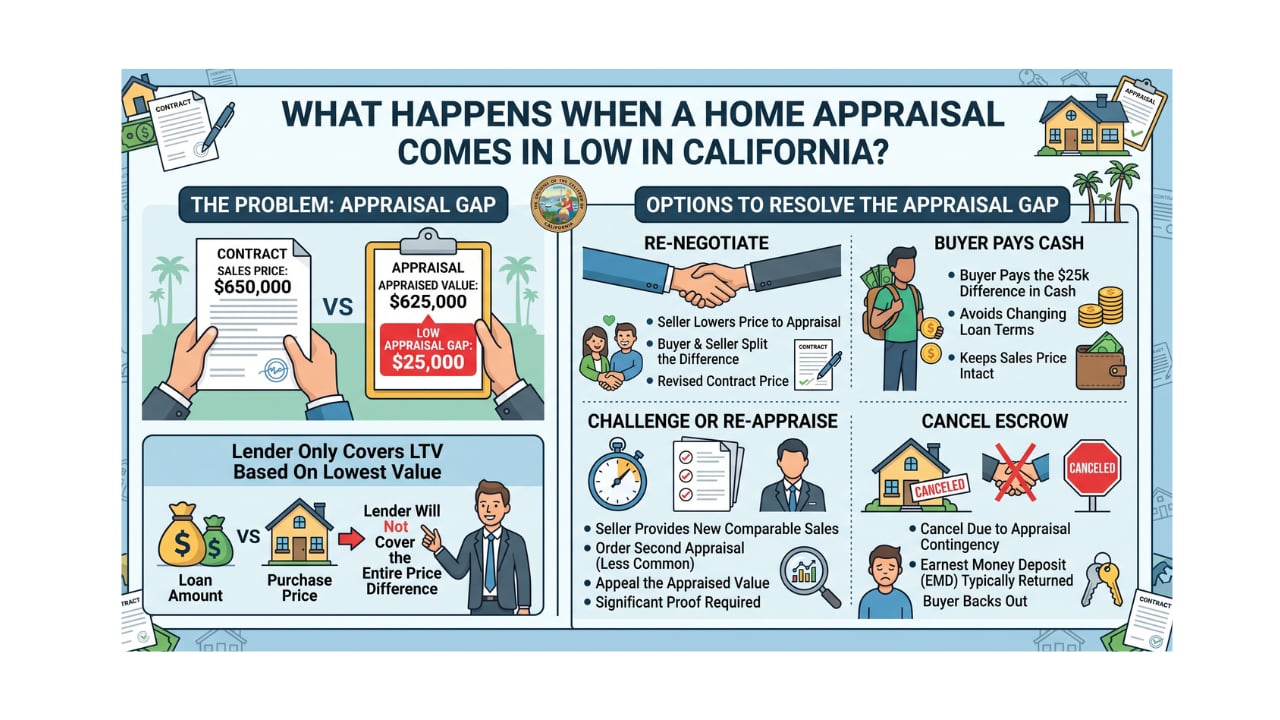
What Happens When a Home Appraisal Comes in Low in California?
When a home appraises below the contract price in California, the lender will only finance based on the appraised value — not what the parties agreed to pay. This creates a gap the buyer must cover in cash, negotiate with the seller, or resolve before closing. Under the California Association of Realtors (CAR) Residential Purchase Agreement, the appraisal contingency defaults to 17 days from acceptance. If the parties can't resolve the gap within that window, the buyer can cancel the contract in writing and receive the earnest money deposit back.
By Kasama Lee, REALTOR® | RE/MAX Gold | DRE #01408667 | September 6, 2026
The appraisal report just came back lower than the contract price. Now what?
This is one of the most stressful moments in any California transaction — and one of the most misunderstood. Buyers assume the deal is dead. Sellers assume they're stuck. Neither is automatically true.
Here's what actually happens, and what both sides can do about it.
Why a Low Appraisal Creates a Problem
Your lender will only loan against the appraised value, not the purchase price. So if you agreed to pay $850,000 for a home in American Canyon and the appraiser says it's worth $820,000, the lender bases your loan on $820,000.
That $30,000 gap doesn't disappear. Someone has to account for it — and that's where the negotiation begins.
The California Appraisal Contingency
Under the standard CAR Residential Purchase Agreement, the appraisal contingency is a standalone written contingency. The default is 17 days from acceptance.
That 17-day window is your safety net as a buyer. If the appraisal comes in low and you can't resolve the gap with the seller, you can deliver written notice of cancellation before the contingency expires and get your earnest money back.
Miss that deadline? The contingency lapses. Your deposit becomes at risk — and backing out could mean walking away without it.
This is one of the reasons I tell every buyer I work with: know your contingency dates. They aren't suggestions.
What Buyers Can Do When the Appraisal Comes in Low
You have more options than you probably realize.
1. Pay the Gap in Cash
If you have the funds, you can bring extra cash to cover the difference between the appraised value and the purchase price. This is common in competitive markets where the buyer knew they might be stretching above appraisal to win the deal.
The math: if your contract price is $850,000 and the appraisal comes in at $820,000, your lender lends on $820,000. You cover your down payment on that base — plus the $30,000 gap. Total cash needed goes up by $30,000.
2. Renegotiate with the Seller
This is the most common resolution in a balanced market. Buyers ask sellers to reduce the price to the appraised value or meet somewhere in the middle.
Sellers often agree — because if this buyer walks, the next buyer's appraisal will almost certainly come in at the same number. The appraised value tends to follow the home, not the buyer.
3. Split the Difference
Buyer and seller each absorb part of the gap. The buyer comes up some cash; the seller drops the price some. It's often the cleanest path when both parties are motivated to close.
4. Request a Reconsideration of Value
If you believe the appraisal is wrong — comparable sales were missed, the appraiser used outdated data, or active construction in the area wasn't accounted for — you can request a formal Reconsideration of Value (ROV) through your lender.
This isn't a casual ask. You need documented, specific evidence: MLS records for comparable sales, square footage adjustments, recent closed sales within the past 90 days. Your agent can help pull these.
Appraisers aren't infallible. I've seen successful ROVs close gaps of $15,000–$40,000, particularly in newer construction areas where comps are thinner. In American Canyon and parts of Vacaville, where new home sales are creating a new comp landscape, this matters more than you might think.
5. Cancel the Contract
If you can't bridge the gap and the seller won't negotiate, you can cancel — as long as your appraisal contingency is still active. You'll get your earnest money back. It stings, but it protects you from overpaying.
What Sellers Can Do
A low appraisal doesn't mean your home isn't worth what the market offered. But it does mean you have a financing problem to solve.
Negotiate a price reduction. The path of least resistance. If the comps genuinely support a lower number, meeting the buyer at the appraised value protects both sides and keeps the deal alive. In a market where over 46% of sales involved seller concessions as of mid-2026, flexibility often wins.
Offer a credit in lieu of a price cut. Rather than dropping the purchase price — which sets a new comp that affects your neighbors' future sales — you can offer a closing cost credit that helps the buyer cover part of the gap. This approach is worth thinking through carefully: the tradeoff between concessions and price reductions matters to your bottom line and to the comparable sales your neighborhood will use for years.
Counter at a split. If the gap is manageable, propose that buyer and seller each absorb half. It demonstrates good faith without fully conceding on price.
Let the deal go and re-list. If the buyer's appraised value feels genuinely wrong and you have strong data to support a higher price, you can allow the contingency to lapse and return to the market. But understand: the next buyer's appraisal will very likely come in at the same number. Unless you have documented evidence the first appraisal was flawed, price discovery through a second deal usually confirms the first.
California-Specific Details Worth Knowing
Appraisal contingency timing is strict. The 17-day default in the CAR RPA is not automatic after the fact. Both parties can negotiate a different timeline in the purchase agreement — and some competitive offers waive the contingency entirely. If you're a buyer who waived the appraisal contingency to compete, you're on the hook for the gap regardless of what the appraiser says.
Lenders order their own appraiser. In California, lenders use licensed independent appraisers assigned through an Appraisal Management Company (AMC). Neither the buyer nor seller selects or can direct the appraiser — which is why disputes go through the formal ROV process rather than a simple phone call.
FHA and VA loans add complexity. Government-backed loans have stricter appraisal requirements. If an FHA or VA appraisal comes in low, the appraised value typically stays with the property for a period — meaning a second buyer using the same loan type will face the same ceiling. For sellers in Vallejo and American Canyon, where FHA and VA buyers represent a meaningful portion of the market, this is important to factor into any re-listing strategy.
If you're selling and buying at the same time, a low appraisal on either side of that equation can cascade — one more reason to have a clear picture of your net proceeds before you list.
The deal isn't dead. It's a negotiation point. Most low-appraisal situations resolve without a canceled contract when both sides are motivated and working with experienced agents who know how to navigate them.
Frequently Asked Questions
Can a seller refuse to lower the price after a low appraisal in California?
Yes. A seller has no legal obligation to reduce the price to match the appraised value. However, if the buyer's appraisal contingency is still active, the buyer can cancel the contract and receive the earnest money back. The seller would then need to re-list — and likely encounter the same appraised value with the next buyer.
How long does the buyer have to respond to a low appraisal in California?
Under the standard CAR Residential Purchase Agreement, the appraisal contingency defaults to 17 days from acceptance. After that, the contingency lapses unless it has been actively extended in writing. Buyers must act — request a Reconsideration of Value, renegotiate, or cancel — before the deadline passes.
What is a Reconsideration of Value (ROV) and does it work?
An ROV is a formal process where the buyer's lender submits documented evidence — additional comparable sales, factual errors in the report, missed adjustments — to the appraiser for reconsideration. ROVs can work when there are genuine errors or missing data, but they're not a simple second opinion request. The appraiser reviews the evidence and may or may not revise the value.
Can the seller's agent order a second appraisal?
No. The lender controls the appraisal process. The seller can get an independent appraisal at their own cost for informational purposes, but the lender won't use it — only the appraisal ordered through their AMC counts for loan approval.
What happens if both parties can't agree on a price after a low appraisal?
If the gap can't be resolved and the buyer's appraisal contingency is still active, the buyer cancels in writing and receives their earnest money back. If the contingency has already been removed, backing out would typically mean the buyer loses their deposit — which in California is often 1%–3% of the purchase price.
A low appraisal is a speed bump, not necessarily a deal-killer. The outcome depends on how motivated both sides are, how much the gap is, and whether there's a realistic case for a Reconsideration of Value.
The clearest signal it's worth pushing through: both buyer and seller still want the same outcome.
If you're navigating this right now — on either side of the transaction — I'm happy to walk through what makes sense in your specific situation. If you're a seller, a private listing consultation is the right place to start: we can talk pricing, timing, and how to handle appraisal risk proactively before it becomes an issue. If you're a buyer, a buyer consultation will help you map out your options and next steps.
Either way, schedule a no-pressure conversation at https://kasamasells.com/contact. Sellers can also start with a free home valuation at https://kasamasells.com/home-valuation.
About Kasama Lee, REALTOR®
Kasama Lee is a RE/MAX Gold Realtor® serving American Canyon, Napa, Vallejo, Fairfield, Benicia, Suisun City, and the broader Vallejo-Fairfield-Napa metro since 2004. A Best of Napa County 2024 award-winning team leader and certified real estate coach for Tom Ferry International, Kasama specializes in helping sellers and buyers navigate single-family homes, new construction, and 55+ active adult communities across southern Napa and Solano counties. With more than two decades of local market experience and a partnership with her husband Barton, a CPA, she brings both negotiation expertise and financial clarity to every transaction. Connect with Kasama at kasamasells.com.
Kasama Lee, REALTOR® | RE/MAX Gold | DRE #01408667