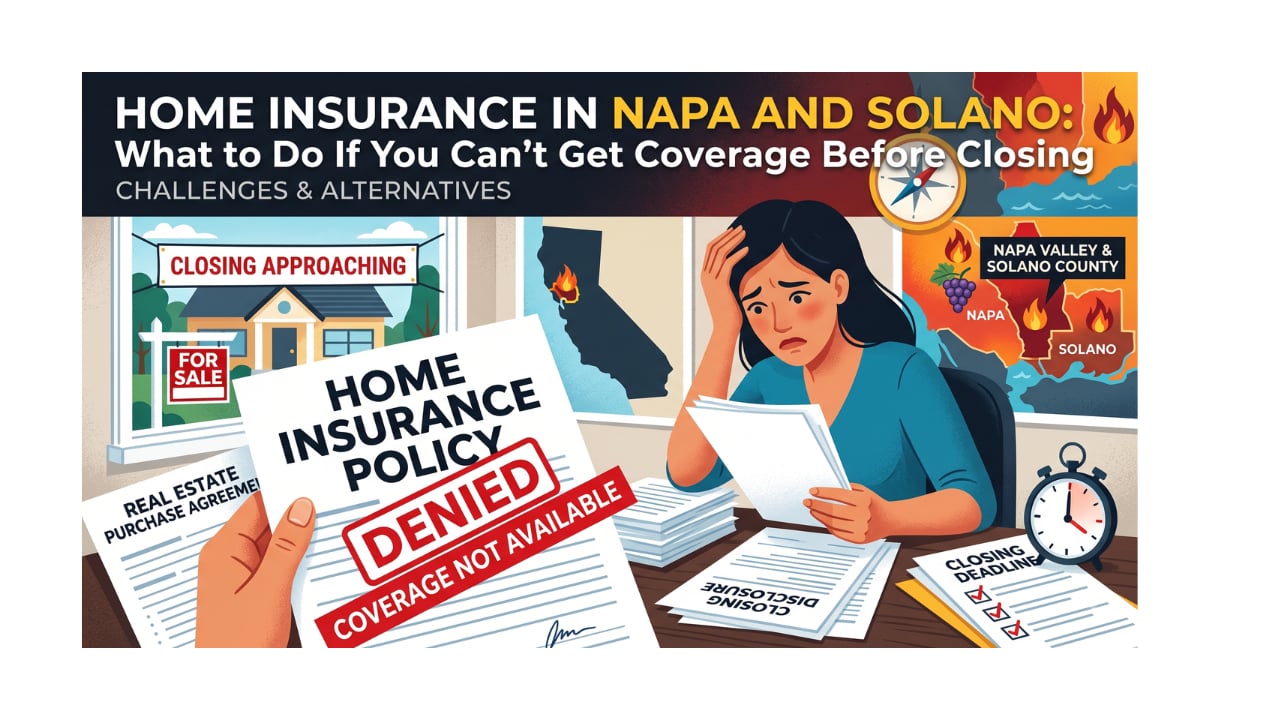
What happens if you can't get homeowners insurance when buying a home in California?
If you can't secure standard homeowners insurance in California, your mortgage lender won't fund the loan — no binder, no close. Buyers who are declined by private carriers can access the California FAIR Plan as a last resort, but FAIR Plan coverage is limited to fire, smoke, and lightning — not liability, theft, or water damage. Most lenders require you to pair FAIR Plan coverage with a Difference in Conditions (DIC) policy to fully satisfy their requirements. As of late 2024, the California standard purchase contract includes a 17-day insurance contingency: if a buyer can't obtain acceptable coverage within that window, they can cancel the contract and keep their earnest money.
By Kasama Lee, REALTOR® | RE/MAX Gold | DRE #01408667 | June 28, 2026
If you're buying or selling a home in American Canyon, Vallejo, Napa, Fairfield, or anywhere across southern Napa and Solano counties right now, there's a question coming up in nearly every transaction that didn't exist five years ago:
Can you actually get homeowners insurance on this property?
And more importantly — what happens to your deal if the answer is complicated?
This is the question that's causing real estate transactions to fall apart across California in 2026. A Stanford University study released this month found that the California FAIR Plan — the state's insurance option of last resort — now covers about 5% of California's single-family homes, up from just 1.5% in 2020. A recent survey found that 1 in 7 realtors has lost a deal this year because buyers couldn't secure coverage — and 31% of buyers reported difficulty getting insurance at all.
In the North Bay counties — including Napa and Sonoma — the situation is particularly pronounced. Average California homeowners insurance premiums have risen 84% since 2020. Some high-risk ZIP codes in Napa County now see fire-only FAIR Plan coverage running nearly $10,000 per year.
This is no longer a background concern for buyers. It's a deal variable — right alongside price, appraisal, and financing.
Why Insurance Has Become a Closing Issue
Here's the core problem: your mortgage lender won't fund your loan without proof of active homeowners insurance.
It's not optional. Before the lender wires funds at closing, they require an insurance binder — a document from a carrier committing to coverage on the property. No binder means no loan means no close.
For years, this was a formality. You called your insurance broker, got a quote, and moved on. Today, in a growing number of California transactions, it's become a multi-step negotiation.
Seven of California's 12 largest home insurers have reduced or stopped writing new policies in the state. The carriers still writing in Napa and Solano counties are often stricter, pricier, or both. Buyers who previously planned on $1,500–$2,000 per year for homeowners insurance are sometimes being quoted $5,000 to $15,000 — or being declined entirely.
When you're declined, you turn to the California FAIR Plan. But the FAIR Plan is not a standard homeowners policy, and understanding what it covers — and what it doesn't — is critical before you close.
What the FAIR Plan Covers (and What It Doesn't)
The California FAIR Plan (Fair Access to Insurance Requirements) is a state-mandated association of insurers that provides basic fire insurance when private carriers won't cover a property. To qualify, you typically need to have been declined by at least two private insurers.
What the FAIR Plan covers:
- Fire
- Smoke
- Lightning
- Certain internal explosions (such as a gas line)
What the FAIR Plan does not cover:
- Liability (someone gets hurt on your property)
- Theft
- Water damage from pipes or appliances
- Wind, hail, or flooding
- Personal property beyond the dwelling itself
That last point matters for lenders. A FAIR Plan policy alone doesn't satisfy most lenders' coverage requirements. You need something closer to a comprehensive homeowners policy — and a fire-only FAIR Plan isn't that.
The solution is a FAIR Plan + DIC pairing.
A Difference in Conditions (DIC) policy is a supplemental policy that wraps around your FAIR Plan coverage and fills in the gaps — liability, theft, water damage, and other standard perils. Together, FAIR Plan + DIC gives you roughly equivalent coverage to a traditional homeowners policy.
This pairing works and satisfies most lenders. But it costs more, involves more coordination, and has to be set up through a licensed insurance broker who knows the FAIR Plan system. Budget for it early — ideally before you write your offer.
The 17-Day Insurance Contingency in Your California Purchase Contract
This is the part most buyers don't know about until they're already in escrow.
In late 2024, the California Association of Realtors updated its standard residential purchase agreement to include an insurance contingency. If you cannot obtain acceptable homeowners insurance within 17 days of opening escrow, you have the right to cancel the contract and receive your earnest money back — with no penalty to you.
This was a significant update. Before it existed, a buyer who couldn't get insurance mid-escrow had limited options: pressure the lender, try to negotiate an extension, or potentially lose their deposit if they walked.
The insurance contingency gives buyers a real protection — but there are nuances to understand:
- The 17-day default is negotiable — sellers can counter with a shorter window
- You must actually attempt to obtain insurance for the contingency to be valid — it's not an automatic escape hatch
- The contingency applies to "acceptable" coverage — meaning coverage that satisfies your lender's specific requirements
As a practical matter: get your insurance quote before you finalize your offer, not after acceptance. In Napa and Solano counties, I encourage every buyer I work with to consult with an insurance broker during the pre-offer stage. The 17-day contingency window can pass faster than you expect once you're managing inspections, appraisals, and loan conditions simultaneously.
What Sellers Need to Know Right Now
Sellers aren't passive observers in this shift. The insurability of your home affects your buyer pool — and can affect your sale price.
A property that's difficult to insure narrows your buyer universe to cash buyers or buyers willing to navigate FAIR Plan complexity. Properties in higher fire-hazard zones, homes with aging roofs, or homes near open space and wildland-urban interface areas are more likely to trigger insurance friction during escrow.
There are steps sellers can take before listing:
Wildfire hardening can reduce insurance costs and broaden your buyer pool. California's AB 2167 requires insurers to offer premium discounts for documented wildfire mitigation: defensible space clearing, fire-resistant roofing, enclosed eaves, and ember-resistant vents. If your home already has these features, make sure they're documented before you list. If it doesn't, completing mitigation before going on market can meaningfully improve your buyer's ability to get standard coverage — and their willingness to pay your price.
Disclose what you know. California's AB 38 Wildfire Hardening Disclosure (effective July 1, 2025 for pre-2010 homes in fire hazard zones) is part of your required disclosure package — right alongside the Transfer Disclosure Statement, Seller Property Questionnaire, and Natural Hazard Disclosure. This isn't optional. Your listing agent should walk you through every required form. If you want a detailed breakdown of California's seller disclosure requirements, I covered them in a recent post on what sellers are required to disclose in California.
Price your home with insurance costs in mind. In markets where insurance is expensive or difficult to obtain, buyers are quietly factoring annual premiums into their offer math. A property with straightforward insurance at $2,000 per year and a nearly identical property that costs $9,000 per year to cover are not equally valuable — even if the purchase prices look the same on paper. This is one of the conversations I have with sellers before we ever set a listing price.
The Insurance Landscape in Napa and Solano Counties
Napa County is in the North Bay — a region that experienced some of California's most damaging wildfires in 2017 and 2020, events that fundamentally reshaped insurer risk models in ways still playing out today.
In higher-elevation areas, fire-adjacent hillside properties, and parts of the Napa Valley corridor, FAIR Plan + DIC coverage is increasingly the norm, not the exception. Annual costs in some Napa ZIP codes can run $9,000–$10,000 for fire coverage alone, before the DIC wrapper.
Solano County — including American Canyon, Vallejo, Fairfield, Benicia, and Vacaville — has a more varied landscape. Much of American Canyon and central Vallejo remains accessible to private carriers at more standard premium levels. But areas in Vacaville, unincorporated hillside zones, and properties near Suisun Marsh or open space interface areas face constraints similar to what Napa buyers encounter.
New construction is often easier to insure than older homes. If you're looking at new homes at Enclave at Canyon Estates by Richmond American — which is now actively selling in American Canyon's eastern foothills — the newer construction standards and modern building materials can work in your favor with carriers. That said, even new builds near open space or in fire hazard severity zones warrant an insurance conversation before you sign a purchase agreement.
One date to track: the California Department of Insurance approved a 29.1% average FAIR Plan rate increase, effective October 15, 2026. If you're closing after that date, the insurance cost picture shifts upward again. Anyone in escrow right now with a closing date near or after mid-October should be factoring this into their budget.
Your Pre-Offer Insurance Checklist
Insurance is no longer something you think about after your offer is accepted. Here's what I walk every buyer through before we write:
- Talk to an insurance broker before the offer — not after. Get a bindable quote, or at minimum understand the carrier landscape for that specific property and ZIP code. A good broker will tell you immediately whether standard coverage is available or whether you're looking at FAIR Plan territory.
- Understand the FAIR Plan + DIC pairing. Know what it covers, what it costs, and whether your lender's specific requirements are satisfied by this combination.
- Use the insurance contingency. The 17-day window is there to protect you. Don't waive it under competitive pressure without fully understanding what you're giving up.
- Ask about the property's insurance history. Has it been covered continuously? Did the seller have to switch carriers? Were there prior claims? Has the roof been updated? These details shape what's available to you as the buyer.
- Budget for the full cost. Insurance, property taxes, and HOA or Mello-Roos assessments (on new construction) are the monthly costs that follow you for years. Understanding how insurance fits your overall monthly budget is essential before you commit to a purchase price.
Every transaction is different. What's straightforward for a newly built home in American Canyon may be considerably more complex for an older hillside property in Napa. The only way to know where you stand is to get the information early — and to work with someone who's been navigating this market through all of its shifts.
Frequently Asked Questions
What is the California FAIR Plan, and is it enough for a lender?
The California FAIR Plan is a state-mandated fire insurance pool for homeowners who can't get coverage from private carriers. It covers fire, smoke, lightning, and certain explosions — but not liability, theft, or water damage. Most lenders require a supplemental Difference in Conditions (DIC) policy alongside FAIR Plan coverage to satisfy their insurance requirements. A broker who works with the FAIR Plan can help you set up the pairing so it meets your lender's standards.
What happens in escrow if I can't get homeowners insurance?
Under California's updated standard purchase contract (late 2024), buyers have a 17-day insurance contingency. If you cannot obtain acceptable coverage within that window, you can cancel the contract and receive your earnest money back. If the contingency period passes without action, you may lose the right to cancel on insurance grounds — and potentially forfeit your deposit if you walk away.
How much does homeowners insurance cost in Napa County in 2026?
Costs vary significantly by property, location, and wildfire risk zone. Lower-risk properties in American Canyon or southern Napa County may still obtain private coverage in the $2,000–$3,500 range annually. Higher-risk properties in elevated or fire-adjacent areas of Napa County may see FAIR Plan fire-only coverage running $5,000–$10,000 per year before adding a DIC wrapper. Get a quote before writing an offer — not after acceptance.
Can a seller be required to make wildfire hardening improvements before closing?
California law does not require sellers to complete wildfire hardening as a condition of sale. However, the AB 38 Wildfire Hardening Disclosure (for pre-2010 homes in fire hazard zones, effective July 1, 2025) requires sellers to disclose the home's compliance status. A buyer may negotiate hardening improvements as part of a post-inspection repair request, or may use higher insurance costs as a basis for a price adjustment discussion.
Will FAIR Plan rates go up in 2026?
Yes. The California Department of Insurance approved a 29.1% average rate increase for FAIR Plan policies, effective October 15, 2026. This is a statewide average — properties with higher wildfire exposure may see larger increases. If your close of escrow falls after October 15, factor this rate adjustment into your cost projections.
Insurance has become one of the most consequential conversations in California real estate — and in Napa and Solano counties, it's front and center in 2026. Most transactions close successfully when buyers and sellers understand the landscape early, work with the right insurance broker, and plan ahead. The deals that fall apart are usually the ones where insurance was treated as an afterthought.
If you're a buyer navigating this in your own home search, I'd love to talk it through with you in a private, confidential buyer consultation. We can map out your goals, financing readiness, and the insurance landscape in whatever neighborhoods you're considering — no pressure, just a real conversation. Schedule a consultation at https://kasamasells.com/contact.
If you're a seller thinking about listing, a private listing consultation can help us assess your home's insurance profile, price your property strategically, and position it to attract qualified buyers even in a more constrained insurance market. Schedule at https://kasamasells.com/contact. You can also start with a free home valuation at https://kasamasells.com/home-valuation.
About Kasama Lee, REALTOR®
Kasama Lee is a RE/MAX Gold Realtor® serving American Canyon, Napa, Vallejo, Fairfield, Benicia, Suisun City, and the broader Vallejo-Fairfield-Napa metro since 2004. A Best of Napa County 2024 award-winning team leader and certified real estate coach for Tom Ferry International, Kasama specializes in helping sellers and buyers navigate single-family homes, new construction, and 55+ active adult communities across southern Napa and Solano counties. With more than two decades of local market experience and a partnership with her husband Barton, a CPA, she brings both negotiation expertise and financial clarity to every transaction. Connect with Kasama at kasamasells.com.
Kasama Lee, REALTOR® | RE/MAX Gold | DRE #01408667